|
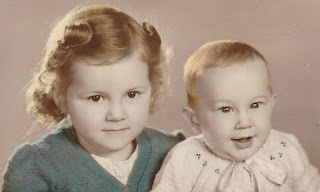
| First family photo with Aldo |
While on furlough, Mother tried to describe her daily life in Argentina in an article titled The life of a Missionary’s Wife.
A dear friend came to me the other day with a long list of questions about our life on the mission field and it made me realize how much you here at home are interested in what we do every day. Things that have become commonplace to us, to you are strange. These are the answers to some of her questions and I hope they will answer some in your mind.
What is our daily routine?
About 7 o’clock we get up, dress in a hurry (if it’s winter) to be ready to get our milk from the milkman about 7:30. He comes with his horse and wagon, measure out our milk from his large milk can and goes on his way through the pueblo. We then put our milk on the stove to boil, and before long we have our breakfast of coffee made with milk, and bread and jelly. Most of the missionaries have adopted this custom of eating such breakfasts for convenience sake and because we are unable to buy cold cereals.
After the dishes are washed the work begins. All the floors must be mopped, and everything dusted. The wind has literally covered the floors with dust and dirt and if we are to live like human beings we must forever be behind the broom and dust rag. I have seen days in La Carlota when five minutes after I dusted, the floors and furniture would be white with a fine dust.
The rush to get dinner begins after the house has been cleaned and dusted. I say dinner because we generally have the larger meal at noon. By that time the vegetable man with his wagon has come and gone and all the vegetables are waiting to be cleaned. We have little use for a can opener. The meat was bought earlier in the morning at the market for 15 cents a pound. We buy every day except Sunday to be able to keep the meat. This term, the Lord willing, we hope to take back a refrigerator and thus save time and energy.
We try to snatch a few minutes rest after dinner in the “siesta” hour, but many times it is the only time that we have to write letters, mend, read, etc. At 3 o’clock we must be on our way either visiting or off to a neighboring town with the loudspeaker. We go up and down the streets of the town for about 2 hours playing gospel records, reading portions of the Scripture, or giving short Gospel messages. As we go we hand out tracts and invite them to the evening meeting. Back in our meeting hall again we eat a little lunch we have prepared and at 9:30 in the summer and 8:30 in the winter our services begin. About 10:30 or 11:00 we gather up our equipment, pile into our car (not a ’51 Buick—most likely a Model A Ford) and bump over the mud roads to our home.
The first thing we do when we get home is to run for the water. It’s not hot, but we don’t mind; we’re only too glad to get clean. This reminds me that we do want to express our appreciation to the ladies of the WMC for making it possible for us on this term, to take back a kerosene hot-water heater. Every time we turn on the hot water, we’ll think of you. At about 12 o’clock we’re ready for bed, weary in body but happy in soul.
Do we send our children to school?
From my own experience I have found that Argentine schools are not very satisfactory. I sent Rita to a native school for about 2 weeks but saw she was getting nowhere. The teachers are not allowed to punish the children and as a result one can always tell an Argentine teacher because their voices are so hoarse. It was always amusing to me to pass a schoolhouse and hear the teachers shouting above the noise of the classroom trying to make themselves heard. Rita came home one day saying that one little boy threatened to kick the teacher that day. Seeing that the noise and confusion in the classroom was such that she couldn’t learn, we sent her to a private teacher. This proved to be very satisfactory.
Her first grade in English I taught as I could with the use of a set of first-grade books, workbooks, etc., which my first-grade teacher gave me when she knew I would have to teach Rita. When we return, we expect to continue with the third grade in the Calvert course.
What are our stores like?
So many times we’ve thought of the self-service supermarkets and wished that the Argentines would introduce such stores. In the morning we set out to buy our groceries: our bread we buy at the baker, our butter at another store, our meat at the market, our baking soda, cream of tartar, etc., at the drug store and our vegetables at the vegetable store—that is, if we have no vegetable man who comes to the door. Instead of going to one store we go to five.
Does it get cold?
The temperature in winter hovers around freezing, not making it quite cold enough for snow but plenty cold to make us want to hang around our wood or kerosene stoves. Our homes are the Spanish-style homes with one room after another in a long line, all opening into the yard or patio. With such an arrangement it makes it impossible to heat the living room and the kitchen. We appreciate every blanket we can put on when we go to bed in our cold, cold bedrooms. Central heating and North American types of house arrangement are just now beginning to come into the larger cities. (The Brethren Missionary Herald, 1.05.52)
It was interesting to read that I was sent to school for a short time. I have no recollection of that experience. However, I am very grateful that later my parents did send me to public school where I learned so much and made many friends.
Aunt Margaret's letters add many colorful details to the last months our two family units lived together in the big house. Not all are flattering, however they add a touch of reality to missionary life.
Sunday, July 16, 1950:We have just risen from a little siesta . . .
I'm glad to see that a little breeze has risen . . . Our water supply depends upon a windmill and if the breeze is not strong enough to pump it, we run out of water. However, in such a case, the Hoyts have a faucet which brings water from another source, so we would never be completely without it.
Kathryn and the children have been resting too, and I'm glad. the children never take naps, and Kathryn never rests; I would think she should, considering how soon the baby is coming. The children get on her nerves pretty much. Their whooping cough is still going strong; these past two or three days they have been vomiting quite a bit. In between coughs you wouldn't know there was anything wrong with them. Sam is away; one of the towns has a church with no pastor and the men take turns supplying the pulpit there. He had to leave here yesterday morning about 8:30 and won't get back until tomorrow afternoon. Kathryn surely didn't want him to go . . . It's a good thing we can be here with Kathryn when Sam is away, for the baby could come at any time. They do have a phone in the house, but evidently it's going to be taken out. Very few people have them.
I do hope we can get settled before the baby comes so I can become adjusted to cooking in this country. I don't know how I'll get along when I have to do it all . . .
We are a bit more settled than we were last week at this time, for our furniture finally came on Wednesday. Sam and Jim were away that day to take care of some business for the mission, so Kathryn, Dorothy and I were here to get it. I would have been willing to have left it at the station until the next morning, but Kathryn wanted to get it, so we got a man with a truck to bring it out. We went down to the station so we could watch, hoping they would be more careful about loading it if we were there. Then when we got it here, we helped unload it, and Kathryn and Dorothy helped take the slats off, even though I protested . . .
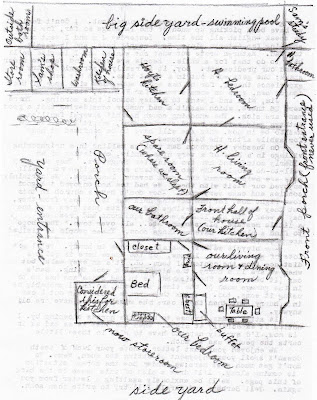
So now we have our bedroom all fixed up, and the dining room part of our other room . .
Margaret drew a house plan to help her readers visualize their accommodations.
Yesterday, Jim and I went shopping for Kathryn since Sam wasn't here, and it wasn't too bad. Kathryn wrote out what she wanted and I imagine we'll have to do that for awhile. People are kind and seem to understand our predicament.
At this point I must insert a funny anecdote I recall. This is my version: Uncle Jim practiced the word he needed all the way to the store, and then forgot, so he said, with a very heavy American accent: "Quiero carne del animal que dice (I want meat from the animal that says), . . . (here he grunted like a pig)."
Jim, Rita and I went to Sunday School this morning. The whooping cough has hit several families. Kathryn gets awfully bored staying home, and it's too bad she has to be in now, when she will have to be confined at home for awhile after the baby comes.
The bicycle we have has already come in handy . . . the house here is quite a distance from the center of town. Oh, it's an easy walk, but when we're in a hurry, the bicycle is a good thing. Sam's car (it belongs to the mission) is in bad shape and has to be in the garage much of the time, so he'll probably use the bicycle some too .
Sunday, August 13, 1950:
It's so terribly dry. Yesterday was quite windy, and how it blew! I had chosen to do a big two-week washing. I had already started before the dust became so bad. We didn't hang any of it up until about 7:00 in the evening. By 10:30, most of it was dry enough . . . The Hoyts have a water tank fixed up so that water can be heated for washing. I guess we'll just use it since we may not be here too long. We're also using their tubs. I don't like to use their things too much, but they don't seem to mind.
No baby yet! Kathryn is just going from one day to the next, expecting each day to be her last one here. I rather dread taking over. I won't mind the cooking but imagine the children will rather worry me. Of course, Sam will be here part of the time and will get them up in the morning. They never take naps, and she lets them go to sleep at night on the couch in the living room or in a chair there, and then puts them in their own beds when she and Sam go to bed. They won't go to sleep usually before 9:30 or 10:00.
This week I had a nice beef roast which provided meat for about four meals. Then, guess what we had yesterday and today? Otter. There's an otter farm near here. The Hoyts bought this one and gave us half for they wanted us to taste it. It's a mild meat, something like pork and yet it has somewhat of a wild taste like rabbit.
Saturday night, August 19, 1950:
I went over tonight and asked the Hoyts over tomorrow for dinner. I feel sorry for them. The baby hasn't come yet, and naturally they are getting rather impatient. Sam has been staying at home all week, missing meetings, just to be sure to be here when the time came. And Kathryn, well I imagine she feels pretty uncomfortable; she says she has a hard time getting around. Tonight Lynn spilt all their milk all over the floor, so I took over our quart.
Dust, dust, dust! Did I tell you that last summer Argentina had the worst drought of its history; the corn crop was a failure, and this dry weather we're experiencing is just a continuation. Sam said there hasn't been any rain worth mentioning for a year. We have been told that cattle are dying for lack of pasture . . .
It was a holiday week, the 100 anniversary of the death of General José San Martín, the "George Washington" of Argentina . . . On Thursday they had a program at the town's plaza and all the school children paraded, a bust of the General was unveiled, and someone made a speech.
Another interesting news item is that the gypsies have come to town. Evidently it happens every so often . . . They have pitched about seven or eight raggedy tents on a vacant field near our house . . . They go around town trying to sell pots and pans, trying to read your palms, asking for money and cigarettes . . .
We have been trying to hear the news reports on the radio which Señor Carranza lent us. We can get them in English every night. It seems terrible to hear nothing but war reports.
P.S.: Monday noon
Sam and Kathryn just left to "buy a baby" as they say here. Rita and Lynn are helping me with the dishes. We are all glad it's finally on the way.
Sunday, August 27, 1950:
This is a very pleasant Sunday afternoon. We were tickled when the wind began to blow before dinner, for we had been out of water for a couple of days. I guess that is worse than the dust we get when the wind blows . . . Last night the moon was so pretty practically full. Jim and I stood in the galería (which is like a porch) and watched it for a little while. Sam doesn't think we'll have any more real cold weather.
Kathryn and the baby came home yesterday afternoon. She seems quite well but I'm afraid she'll overdue. She says she feels quite strong, but the baby will just be a week old tomorrow. The baby is real cute . . . born last Monday afternoon at 3:20. At 1:30 on that day, Kathryn was sitting at our dinner table; they had already been to see the mid-wife and been told it would come between 2:00 and 3:00, so they left here about 1:45. I was glad Sam had a chance to eat before the ordeal; she didn't eat anything . . . Sam came back for us and we saw the baby when it was just an hour old. It was real cute even then, I thought.
I did the cooking all week, and didn't mind it too much. Then we kept the children some--kept Lynn all day while Sam went to Río Cuarto to teach his Institute classes; he took Rita with him. We really enjoyed Lynn; he was quite good--went to bed without any trouble, which was a relief for me. He wouldn't take a nap in the afternoon, but I didn't lift him out of his bed, so he just sat there for an hour. He had a good rest anyway. He keeps us all amused with the things he says, and the way he says them . . . his eyes are a little crossed, but I believe he's about the cutest acting little boy I've ever seen.

On Friday we kept them part of the afternoon and all evening; we all walked over to see Kathryn and the baby after supper. During the night Rita got sick , and still isn't feeling right. I surely hated for her to be that way when Kathryn came home. I felt we probably shouldn't have walked over to see Kathryn, it's a long walk, and Rita was pretty tired from having been at Río Cuarto all the day before.
I enjoyed cooking in the Hoyt's kitchen because of having the oven to use. About every day I made a dessert in the oven--a lemon pudding, a peach upside down cake, a cottage pudding and a white cake for Kathryn when she got home. And today--ice cream! We made it in the Hoyt's freezer. You can't always get ice in the winter, but they were able to today. Sam really likes it. We used some very heavy whipping cream you can get here almost every week. Sam bought the Argentine meal they always get on Sunday for all of us, and we did enjoy it.
Life was now very full. So there are very few photos of baby Aldo. This earliest one is my favorite.
Baby's bath time and adoring siblings

Saturday night, December 10, 1950:
Just think--Christmas only two weeks away! We have received more boxes . . . People surely have been good to us . . . We were so tickled with the Little Golden Books . . . sent for us to give to Rita and Lynn. They are so nice, and I know the children will just love them. They have so few books, and they look at them over and over again, and seem to enjoy them so much.
Last Tuesday night Jim and I planned a wiener roast for the benefit of the two girls who were here teaching Bible School . . . I made ice cream for the occasion . . . Sam and Kathryn really seemed to enjoy it, and the girls too.
Sunday, December 18, 1950:
Sam has been helping Lynn Schrock hold a series of meetings in Río Cuarto. He went over Thursday morning and the meetings will last through next Saturday. It's kinda bad for him to be gone all the time for Kathryn really has her hands full with the three kids. However, he came home this morning in order to be here for the service tonight. Then I suppose he'll go back tomorrow.
Did I tell you that I'm going to have the Schrocks and Hoyts over for Christmas dinner?
Monday, December 25, 1950:
Well, our first Christmas in Argentina is almost over, and it was really very nice. I can't say that it seemed like Christmas though. I believe yesterday and today were the hottest days of my experience.
But in spite of the weather, it was a nice day, and I'm glad I had the folks here. I think they all relaxed more than they have for a long, long time. Kathryn especially seemed to enjoy it and she deserves a rest.
After dinner, we sat around in our living room, talked, looked at pictures, sang carols, then opened some presents. Miss Nielsen brought something for everyone and then the Schrocks and Hoyts gave to the children of the other family. The five children were really very good all day. It surely is more fun at Christmas time to have children around.
Jim and I opened all our packages last night. My, what an assortment of gifts . . .one very pretty scarf I gave to Kathryn for it was just the right color for her read hair . . .We gave the Hoyts all something and they seem to really appreciate it so much, for they just couldn't afford to give each other too much. The children enjoyed their books so much, and Jim made a swing for them which they surely like.
Wednesday, January 3, 1951:
Sam and Lynn Schrock are conducting a tent meeting here this week. It means a meeting every night, beginning at 9:30, so usually it's 11:00 or 11:30 before we get home . . . Jim goes out every afternoon about 6:00 to use the loud speaking system all over town, advertising the meetings and playing gospel records. They stay out about 2 hours. Then we have a prayer meeting every afternoon to pray for the meetings. Then we have the whole Schrock family to cook for. They all came over Monday morning and will leave Thursday night after the meeting.
This is Lynny Boy's birthday; he's three today. We went over after dinner to watch him blow out the candles . . . The kids are having a big time this week with Becky and Normy Schrock here.

We'll have to move in March, for they decided to have the Bible Institue here next year, instead of in Río Cuarto, and that will start in April. The Dowdys will be living here, and they will be returning from the States in March, so both the Hoyts and we will have to be moving before. The Hoyts are due for furlough, but have offered to stay for six more months, in order that there be someone in every town where we have a work established.
The Schrocks gave Rita and Lynn three rabbits for Christmas, real ones. The [wild] dogs got into the pen one night and ate one of them, and just the night before last they ate the other two. It's a shame they didn't have them fixed more securely, for Rita and Lynn enjoyed them so.
Friday, January 19. 1951:
The missionaries had a short field council meeting the day we came back from camp, since all the men except Sam were going to be there in Río Cuarto. They wanted to decide whether the Hoyts stay an extra six months before going home on furlough. It seemed better to have them stay, and the Hoyts were willing, so guess they will. The Hoyts and the Maconaghys are both going to be moving to Río Cuarto around the last of March, and we will be moving to Corral de Bustos.
Thus ends the narrative of daily life in the big house assembled from excerpts from Aunt Margaret's letters. There remains one memory of my very own that has stayed with me all these years.

I was out in the back patio alone. One of the men, who helped Dad a lot and faithfully attended the services, rode up on his bike. Innocently, I ran to the gate to welcome him. What he did and said next were weirdly strange to me, and wrong, I knew. So I ran!
A few years ago when I was reading their old letters to Mother, I understood from my own experience what my parents had not comprehended in those early days. Dad wrote in their weekly letter of July 14, 1946:
Yesterday we had something happen which was rather strange. We ate with the hired girl in the kitchen so that we could practice talking Spanish. In the course of the conversation she told us that about a year ago there used to be more folks come to the meetings . . .[one reason] because they do not like one of the believers--Señor C . . .
Then, at the women's meeting this afternoon as the women were saying goodbye to each other, they say "Hasta luego" if they expect to see you again the same day. Mrs. Dowdy said "Hasta luego" to some of these women expecting to see them again at the regular meeting at night. But they said, "No, it's too cold." Then the truth came out , they said they didn't care to come to the services for there was a dog who regularly attended. They referred to this Señor C.
Sometime after, I found similar references in the Marshall's letters a few years later.
I escaped the incident unharmed, mostly perplexed. My life carried on happily. I didn't tell my parents till much later and cannot remember how it came up. However, the memory never left me.
Now, in retrospect, I am sad to think of those he harmed with his corrupt behavior. I am sad for his wife and family. I am sad thinking of the naive new missionaries he deceived.
Our world is full of such people consumed by unbridled passions, some even professing to follow Christ. I am deeply saddened by the fall of Christian leaders and the plight of their victims.
Then I think of David in the Bible, "a man after God's own heart (Acts 13:22)." How is that possible when David committed adultery and then plotted to have Bathsheba's husband killed? He repented of his sin when confronted by the prophet Nathan. Psalm 51 expresses his deep repentance. Even though he was restored to fellowship and the joy of his salvation, he did suffer consequences throughout his lifetime--his son died, the one born from his union with Bathsheba; he was not allowed to build the temple because he had shed blood.
I never knew what happened to Mr. C from La Carlota, but the Gospel message remains: Repent and be saved!