Tuesday, November 30, 2021

Life in the Big House


First family photo with Aldo

    While on furlough, Mother tried to describe her daily life in Argentina in an article titled The life of a Missionary’s Wife.

    A dear friend came to me the other day with a long list of questions about our life on the mission field and it made me realize how much you here at home are interested in what we do every day. Things that have become commonplace to us, to you are strange. These are the answers to some of her questions and I hope they will answer some in your mind.

What is our daily routine?

    About 7 o’clock we get up, dress in a hurry (if it’s winter) to be ready to get our milk from the milkman about 7:30. He comes with his horse and wagon, measure out our milk from his large milk can and goes on his way through the pueblo. We then put our milk on the stove to boil, and before long we have our breakfast of coffee made with milk, and bread and jelly. Most of the missionaries have adopted this custom of eating such breakfasts for convenience sake and because we are unable to buy cold cereals.

    After the dishes are washed the work begins. All the floors must be mopped, and everything dusted. The wind has literally covered the floors with dust and dirt and if we are to live like human beings we must forever be behind the broom and dust rag. I have seen days in La Carlota when five minutes after I dusted, the floors and furniture would be white with a fine dust.

    The rush to get dinner begins after the house has been cleaned and dusted. I say dinner because we generally have the larger meal at noon. By that time the vegetable man with his wagon has come and gone and all the vegetables are waiting to be cleaned. We have little use for a can opener. The meat was bought earlier in the morning at the market for 15 cents a pound. We buy every day except Sunday to be able to keep the meat. This term, the Lord willing, we hope to take back a refrigerator and thus save time and energy.

    We try to snatch a few minutes rest after dinner in the “siesta” hour, but many times it is the only time that we have to write letters, mend, read, etc. At 3 o’clock we must be on our way either visiting or off to a neighboring town with the loudspeaker. We go up and down the streets of the town for about 2 hours playing gospel records, reading portions of the Scripture, or giving short Gospel messages. As we go we hand out tracts and invite them to the evening meeting. Back in our meeting hall again we eat a little lunch we have prepared and at 9:30 in the summer and 8:30 in the winter our services begin. About 10:30 or 11:00 we gather up our equipment, pile into our car (not a ’51 Buick—most likely a Model A Ford) and bump over the mud roads to our home.

    The first thing we do when we get home is to run for the water. It’s not hot, but we don’t mind; we’re only too glad to get clean. This reminds me that we do want to express our appreciation to the ladies of the WMC for making it possible for us on this term, to take back a kerosene hot-water heater. Every time we turn on the hot water, we’ll think of you. At about 12 o’clock we’re ready for bed, weary in body but happy in soul.

Do we send our children to school?

    From my own experience I have found that Argentine schools are not very satisfactory. I sent Rita to a native school for about 2 weeks but saw she was getting nowhere. The teachers are not allowed to punish the children and as a result one can always tell an Argentine teacher because their voices are so hoarse. It was always amusing to me to pass a schoolhouse and hear the teachers shouting above the noise of the classroom trying to make themselves heard. Rita came home one day saying that one little boy threatened to kick the teacher that day. Seeing that the noise and confusion in the classroom was such that she couldn’t learn, we sent her to a private teacher. This proved to be very satisfactory.
    Her first grade in English I taught as I could with the use of a set of first-grade books, workbooks, etc., which my first-grade teacher gave me when she knew I would have to teach Rita. When we return, we expect to continue with the third grade in the Calvert course.

What are our stores like?

    So many times we’ve thought of the self-service supermarkets and wished that the Argentines would introduce such stores. In the morning we set out to buy our groceries: our bread we buy at the baker, our butter at another store, our meat at the market, our baking soda, cream of tartar, etc., at the drug store and our vegetables at the vegetable store—that is, if we have no vegetable man who comes to the door. Instead of going to one store we go to five.

Does it get cold?

    The temperature in winter hovers around freezing, not making it quite cold enough for snow but plenty cold to make us want to hang around our wood or kerosene stoves. Our homes are the Spanish-style homes with one room after another in a long line, all opening into the yard or patio. With such an arrangement it makes it impossible to heat the living room and the kitchen. We appreciate every blanket we can put on when we go to bed in our cold, cold bedrooms. Central heating and North American types of house arrangement are just now beginning to come into the larger cities. (The Brethren Missionary Herald, 1.05.52)

    It was interesting to read that I was sent to school for a short time. I have no recollection of that experience. However, I am very grateful that later my parents did send me to public school where I learned so much and made many friends.

    Aunt Margaret's letters add many colorful details to the last months our two family units lived together in the big house. Not all are flattering, however they add a touch of reality to missionary life.

    Sunday, July 16, 1950:
    We have just risen from a little siesta . . . 
    I'm glad to see that a little breeze has risen . . . Our water supply depends upon a windmill and if the breeze is not strong enough to pump it, we run out of water. However, in such a case, the Hoyts have a faucet which brings water from another source, so we would never be completely without it.

    Kathryn and the children have been resting too, and I'm glad. the children never take naps, and Kathryn never rests; I would think she should, considering how soon the baby is coming. The children get on her nerves pretty much. Their whooping cough is still going strong; these past two or three days they have been vomiting quite a bit. In between coughs you wouldn't know there was anything wrong with them. Sam is away; one of the towns has a church with no pastor and the men take turns supplying the pulpit there. He had to leave here yesterday morning about 8:30 and won't get back until tomorrow afternoon. Kathryn surely didn't want him to go . . . It's a good thing we can be here with Kathryn when Sam is away, for the baby could come at any time. They do have a phone in the house, but evidently it's going to be taken out. Very few people have them.

    I do hope we can get settled before the baby comes so I can become adjusted to cooking in this country. I don't know how I'll get along when I have to do it all . . .

    We are a bit more settled than we were last week at this time, for our furniture finally came on Wednesday. Sam and Jim were away that day to take care of some business for the mission, so Kathryn, Dorothy and I were here to get it. I would have been willing to have left it at the station until the next morning, but Kathryn wanted to get it, so we got a man with a truck to bring it out. We went down to the station so we could watch, hoping they would be more careful about loading it if we were there. Then when we got it here, we helped unload it, and Kathryn and Dorothy helped take the slats off, even though I protested . . .

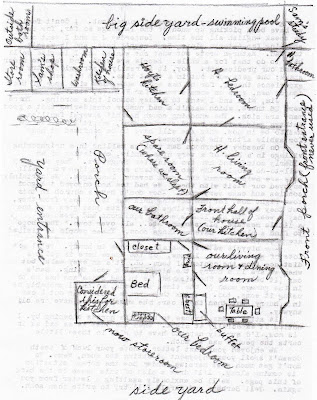
    So now we have our bedroom all fixed up, and the dining room part of our other room . .

    Margaret drew a house plan to help her readers visualize their accommodations.
    Yesterday, Jim and I went shopping for Kathryn since Sam wasn't here, and it wasn't too bad. Kathryn wrote out what she wanted and I imagine we'll have to do that for awhile. People are kind and seem to understand our predicament.

    At this point I must insert a funny anecdote I recall. This is my version: Uncle Jim practiced the word he needed all the way to the store, and then forgot, so he said, with a very heavy American accent: "Quiero carne del animal que dice (I want meat from the animal that says), . . . (here he grunted like a pig)."

    Jim, Rita and I went to Sunday School this morning. The whooping cough has hit several families. Kathryn gets awfully bored staying home, and it's too bad she has to be in now, when she will have to be confined at home for awhile after the baby comes.

    The bicycle we have has already come in handy . . . the house here is quite a distance from the center of town. Oh, it's an easy walk, but when we're in a hurry, the bicycle is a good thing. Sam's car (it belongs to the mission) is in bad shape and has to be in the garage much of the time, so he'll probably use the bicycle some too . 

Sunday, August 13, 1950:

    It's so terribly dry. Yesterday was quite windy, and how it blew! I had chosen to do a big two-week washing. I had already started before the dust became so bad. We didn't hang any of it up until about 7:00 in the evening. By 10:30, most of it was dry enough . . . The Hoyts have a water tank fixed up so that water can be heated for washing. I guess we'll just use it since we may not be here too long. We're also using their tubs. I don't like to use their things too much, but they don't seem to mind.

    No baby yet! Kathryn is just going from one day to the next, expecting each day to be her last one here. I rather dread taking over. I won't mind the cooking but imagine the children will rather worry me. Of course, Sam will be here part of the time and will get them up in the morning. They never take naps, and she lets them go to sleep at night on the couch in the living room or in a chair there, and then puts them in their own beds when she and Sam go to bed. They won't go to sleep usually before 9:30 or 10:00.

    This week I had a nice beef roast which provided meat for about four meals. Then, guess what we had yesterday and today?  Otter. There's an otter farm near here. The Hoyts bought this one and gave us half for they wanted us to taste it. It's a mild meat, something like pork and yet it has somewhat of a wild taste like rabbit.

Saturday night, August 19, 1950:

    I went over tonight and asked the Hoyts over tomorrow for dinner. I feel sorry for them. The baby hasn't come yet, and naturally they are getting rather impatient. Sam has been staying at home all week, missing meetings, just to be sure to be here when the time came. And Kathryn, well I imagine she feels pretty uncomfortable; she says she has a hard time getting around. Tonight Lynn spilt all their milk all over the floor, so I took over our quart.  

     Dust, dust, dust! Did I tell you that last summer Argentina had the worst drought of its history; the corn crop was a failure, and this dry weather we're experiencing is just a continuation. Sam said there hasn't been any rain worth mentioning for a year. We have been told that cattle are dying for lack of pasture . . . 

    It was a holiday week, the 100 anniversary of the death of General José San Martín, the "George Washington" of Argentina . . .  On Thursday they had a program at the town's plaza and all the school children paraded, a bust of the General was unveiled, and someone made a speech.

    Another interesting news item is that the gypsies have come to town. Evidently it happens every so often . . . They have pitched about seven or eight raggedy tents on a vacant field near our house . . . They go around town trying to sell  pots and pans, trying to read your palms, asking for money and cigarettes . . .

    We have been trying to hear the news reports on the radio which Señor Carranza lent us. We can get them in English every night. It seems terrible to hear nothing but war reports.

P.S.: Monday noon

    Sam and Kathryn just left to "buy a baby" as they say here. Rita and Lynn are helping me with the dishes. We are all glad it's finally on the way.

Sunday, August 27, 1950:

    This is a very pleasant Sunday afternoon. We were tickled when the wind began to blow before dinner, for we had been out of water for a couple of days. I guess that is worse than the dust we get when the wind blows . . . Last night the moon was so pretty practically full. Jim and I stood in the galería (which is like a porch) and watched it for a little while. Sam doesn't think we'll have any more real cold weather.

     Kathryn and the baby came home yesterday afternoon. She seems quite well but I'm afraid she'll overdue. She says she feels quite strong, but the baby will just be a week old tomorrow. The baby is real cute . . . born last Monday afternoon at 3:20. At 1:30 on that day, Kathryn was sitting at our dinner table; they had already been to see the mid-wife and been told it would come between 2:00 and 3:00, so they left here about 1:45. I was glad Sam had a chance to eat before the ordeal; she didn't eat anything . . . Sam came back for us and we saw the baby when it was just an hour old. It was real cute even then, I thought.

    I did the cooking all week, and didn't mind it too much. Then we kept the children some--kept Lynn all day while Sam went to Río Cuarto to teach his Institute classes; he took Rita with him. We really enjoyed Lynn; he was quite good--went to bed without any trouble, which was a relief for me. He wouldn't take a nap in the afternoon, but I didn't lift him out of his bed, so he just sat there for an hour. He had a good rest anyway. He keeps us all amused with the things he says, and the way he says them . . . his eyes are a little crossed, but I believe he's about the cutest acting little boy I've ever seen.


    On Friday we kept them part of the afternoon and all evening; we all walked over to see Kathryn and the baby after supper. During the night Rita got sick , and still isn't feeling right. I surely hated for her to be that way when Kathryn came home. I felt we probably shouldn't have walked over to see Kathryn, it's a long walk, and Rita was pretty tired from having been at Río Cuarto all the day before.

    I enjoyed cooking in the Hoyt's kitchen because of having the oven to use. About every day I made a dessert in the oven--a lemon pudding, a peach upside down cake, a cottage pudding and a white cake for Kathryn when she got home. And today--ice cream! We made it in the Hoyt's freezer. You can't always get ice in the winter, but they were able to today. Sam really likes it. We used some very heavy whipping cream you can get here almost every week. Sam bought the Argentine meal they always get on Sunday for all of us, and we did enjoy it. 

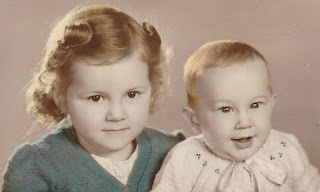
    Life was now very full. So there are very few photos of baby Aldo. This earliest one is my favorite.   

Baby's bath time and adoring siblings

    Saturday night, December 10, 1950:

    Just think--Christmas only two weeks away! We have received more boxes . . . People surely have been good to us . . . We were so tickled with the Little Golden Books . . . sent for us to give to Rita and Lynn. They are so nice, and I know the children will just love them. They have so few books, and they look at them over and over again, and seem to enjoy them so much.

    Last Tuesday night Jim and I planned a wiener roast for the benefit of the two girls who were here teaching Bible School . . . I made ice cream for the occasion . . . Sam and Kathryn really seemed to enjoy it, and the girls too.

    Sunday, December 18, 1950:

    Sam has been helping Lynn Schrock hold a series of meetings in Río Cuarto. He went over Thursday morning and the meetings will last through next Saturday. It's kinda bad for him to be gone all the time for Kathryn really has her hands full with the three kids. However, he came home this morning in order to be here for the service tonight. Then I suppose he'll go back tomorrow.

    Did I tell you that I'm going to have the Schrocks and Hoyts over for Christmas dinner? 

    Monday, December 25, 1950:

    Well, our first Christmas in Argentina is almost over, and it was really very nice. I can't say that it seemed like Christmas though. I believe yesterday and today were the hottest days of my experience.

    But in spite of the weather, it was a nice day, and I'm glad I had the folks here. I think they all relaxed more than they have for a long, long time. Kathryn especially seemed to enjoy it and she deserves a rest. 

    After dinner, we sat around in our living room, talked, looked at pictures, sang carols, then opened some presents. Miss Nielsen brought something for everyone and then the Schrocks and Hoyts gave to the children of the other family. The five children were really very good all day. It surely is more fun at Christmas time to have children around. 

    Jim and I opened all our packages last night. My, what an assortment of gifts . . .one very pretty scarf I gave to Kathryn for it was just the right color for her read hair . . .We gave the Hoyts all something and they seem to really appreciate it so much, for they just couldn't afford to give each other too much. The children enjoyed their books so much, and Jim made a swing for them which they surely like.

    Wednesday, January 3, 1951:

    Sam and Lynn Schrock are conducting a tent meeting here this week. It means a meeting every night, beginning at 9:30, so usually it's 11:00 or 11:30 before we get home . . . Jim goes out every afternoon about 6:00 to use the loud speaking system all over town, advertising the meetings and playing gospel records. They stay out about 2 hours. Then we have a prayer meeting every afternoon to pray for the meetings. Then we have the whole Schrock family to cook for. They all came over Monday morning and will leave Thursday night after the meeting.

    This is Lynny Boy's birthday; he's three today. We went over after dinner to watch him blow out the candles . . . The kids are having a big time this week with Becky and Normy Schrock here.  

    We'll have to move in March, for they decided to have the Bible Institue here next year, instead of in Río Cuarto, and that will start in April. The Dowdys will be living here, and they will be returning from the States in March, so both the Hoyts and we will have to be moving before. The Hoyts are due for furlough, but have offered to stay for six more months, in order that there be someone in every town where we have a work established. 

    The Schrocks gave Rita and Lynn three rabbits for Christmas, real ones. The [wild] dogs got into the pen one night and ate one of them, and just the night before last they ate the other two. It's a shame they didn't have them fixed more securely, for Rita and Lynn enjoyed them so. 

    Friday, January 19. 1951:

    The missionaries had a short field council meeting the day we came back from camp, since all the men except Sam were going to be there in Río Cuarto. They wanted to decide whether the Hoyts stay an extra six months before going home on furlough. It seemed better to have them stay, and the Hoyts were willing, so guess they will. The Hoyts and the Maconaghys are both going to be moving to Río Cuarto around the last of March, and we will be moving to Corral de Bustos.

    Thus ends the narrative of daily life in the big house assembled from excerpts from Aunt Margaret's letters. There remains one memory of my very own that has stayed with me all these years. 


    I was out in the back patio alone. One of the men, who helped Dad a lot and faithfully attended the services, rode up on his bike. Innocently, I ran to the gate to welcome him. What he did and said next were weirdly strange to me, and wrong, I knew. So I ran!

    A few years ago when I was reading their old letters to Mother, I understood from my own experience what my parents had not comprehended in those early days. Dad wrote in their weekly letter of July 14, 1946:

    Yesterday we had something happen which was rather strange. We ate with the hired girl in the kitchen so that we could practice talking Spanish. In the course of the conversation she told us that about a year ago there used to be more folks come to the meetings . . .[one reason] because they do not like one of the believers--Señor C . . . 
    Then, at the women's meeting this afternoon as the  women were saying goodbye to each other, they say "Hasta luego" if they expect to see you again the same day. Mrs. Dowdy said "Hasta luego" to some of these women expecting to see them again at the regular meeting at night. But they said, "No, it's too cold." Then the truth came out , they said they didn't care to come to the services for there was a dog who regularly attended. They referred to this Señor C.

    Sometime after, I found similar references in the Marshall's letters a few years later. 

    I escaped the incident unharmed, mostly perplexed. My life carried on happily. I didn't tell my parents till much later and cannot remember how it came up. However, the memory never left me. 

    Now, in retrospect, I am sad to think of those he harmed with his corrupt behavior. I am sad for his wife and family. I am sad thinking of the naive new missionaries he deceived.

    Our world is full of such people consumed by unbridled passions, some even professing to follow Christ. I am deeply saddened by the fall of Christian leaders and the plight of their victims.

    Then I think of David in the Bible, "a man after God's own heart (Acts 13:22)." How is that possible when David committed adultery and then plotted to have Bathsheba's husband killed? He repented of his sin when confronted by the prophet Nathan. Psalm 51 expresses his deep repentance. Even though he was restored to fellowship and the joy of his salvation, he did suffer consequences throughout his lifetime--his son died, the one born from his union with Bathsheba; he was not allowed to build the temple because he had shed blood.

    I never knew what happened to Mr. C from La Carlota, but the Gospel message remains: Repent and be saved!    

Sunday, November 14, 2021

Moves

Last photo as a family of four


    My memory tells me we lived in two places during our time in La Carlota. My parents' letters had mentioned the need to move from the rented house attached to Dr. Gauna's office, but I didn't know when the move took place so I did some research looking for clues. 

    The background in these old photos told me we were still living on Gral. Paz 132 when I celebrated my fourth birthday, 1948.
        

    From the following pictures, I knew that we were there through the winter of 1949 and into early 1950 when Lynn turned two. 


    The new address was not published in the denominational magazine until the July 29th issue of The Brethren Missionary Herald. concluded that I must have been almost six years old when we moved into the doctor's large estate on Jorge Ross 631 sometime in the first half of 1950.


Jorge Ross 631, La Carlota

    In recent years, I acquired an additional source of information--Jim and Margaret Marshall's letters to their families. I am so grateful to "Aunt Margaret" for allowing me to see this treasured collection, a wonderful personal and historical record of their missionary life in Argentina. Their first impressions and early experiences upon arrival in Argentina, add much to the description of life in La Carlota in those days. 

    Margaret wrote on a bright winter afternoon, Sunday July 9, 1950:
It didn't seem very cold this morning when we awoke, but then every room where there is no heat feels pretty cold. Dust storms are common here in this land, and there was one in the air this morning. Most of the roads and streets are dirt and when it is dry, they are just covered with loose dust, and naturally when it is windy, it blows around. The folks say that sometimes in the summer time, the loose dust is so thick on the roads, a car gets stuck in it. Then when it rains, the mud is terrific, they say.

I'm so glad the winter is half over. We are getting more used to the cold and they keep two rooms pretty well heated here at the Hoyts, for which we are very thankful. Our bedroom and bathroom are quite cold.

Dorothy and Hill Maconaghy brought us here to the Hoyt's last Monday. Just before we were ready to leave Corral de Bustos, we received a telegram from the Hoyts saying that the little boy had whooping cough, but that we were welcome to come if we were not afraid. We hardly knew what to think, but I don't believe grown folks very often get the disease, and we were so anxious to get settled and to start studying the language that we came ahead. It seemed awful to impose ourselves on the family at such a time, but we are trying to help and not be any more bother than possible. We had hoped all our things would be here by now, but nothing but our personal effects have come yet; the barrels, cedar chest, bicycle, foot lockers, etc., came through from Buenos Aires the evening we got here, so we were glad we were here to take care of them. We can't unpack yet though for there is no place to put anything. On Tuesday we drove over to Río Cuarto with Sam Hoyt, visited the mission property there, met some more of the missionaries, and went shopping for some of our furniture. . .

The house here is very nice. Kathryn Hoyt has her five rooms fixed up so nicely. The floors are made of a nice wood, and how much warmer they seem than the cold, damp tile ones. Sam is very handy about making things, and he has made so many nice things, such as desks, kitchen cupboards; he is helping Jim with the cupboard for our kitchen. 

The Hoyts have two real cute children, a little girl six years old and a little boy just two and a half. They both have the whooping cough and of course it has been pretty hard on the little boy. It naturally worries Sam and Kathryn a lot. She is expecting another baby in a month, and Sam is very busy trying to be the pastor in four towns and teaching one day a week in the Bible Institute at Río Cuarto, so you can imagine that it is a rather hectic household and that we'll be glad when we can move into our four rooms. We'll have a nice big bathroom, and large bedroom and a combination living room and dining room and a little kitchen . . . This has once been a lovely place, but it's run down now quite a bit. There is a lot of yard, and many big trees. It seems as if we are right out in the country; I surely do like it. It will be so pretty in the summer time.

Well, we celebrated our first wedding anniversary on Thursday. It wasn't much of a celebration, but Kathryn baked a nice chocolate cake for us and put one candle on it. Then Dorothy and Hill sent us a telegram of congratulations.    


I have played the little organ [harmonium] for the two church services they have had in the little church here in town this week--for the prayer meeting on Thursday night and Sunday School this morning. Kathryn stayed with the children. Jim and I are going to sing a duet in Spanish for church this evening. We sang the same thing last Sunday in Corral de Bustos. It's not very good, but perhaps they enjoy it. Sam and Kathryn are good musicians, so know we won't compare with them. Sam has a very nice voice and plays two instruments besides.

    My brother and I loved "Uncle Jim and Aunt Margaret" (as we called them), and they were so welcoming! Once settled in their half of the fifteen-room house, we enjoyed going next door to visit them. Mother had to remind us often to not wear out our welcome. We tended to get in trouble for going over to their place.


    The Marshalls, on the other hand, seemed to delight in our company and were especially taken with Lynn. He was just barely three years old when Margaret wrote the following: 
February 16, 1951 
Lynn has just come in to say good-morning. I wish you could hear him talk. We surely get a kick out of it. He just talks and talks, so distinctly and with such expression in his voice. Then he's getting so that he can talk Spanish better and better, just as distinctly as he speaks English. He's better entertainment than a picture show. I'm afraid our own child will seem dull in comparison, but I don't suppose so.
Rita and Lynn taking turns riding with Uncle Jim


    Margaret wrote about Lynn again later:

March 7, 1951 
Lynn just ran out to go with Jim. He's been asking Jim all day to take him for a ride in the car; (we have the Ford [Model]A of the Schrocks while they are using the Hoyt's in Buenos Aires for a week or so; they had to make the trip to get passports for the children for going home.)
Lynn continues to amaze us with his abilities--he is such a character. He's been coming over to see us more lately, for Kathryn doesn't scold him so much about coming since she knows we won't be here much longer to enjoy him. He will come to the door and say, "I haven't seen you today" or "I want to come see you." If he sees something he'd like to have, he'll say, "I don't have one of these in my house," or "My mama didn't give me none of this." You just have to hear the expression of his voice to really appreciate what he says--his voice will go way up high and then down, and then up again. I guess you would say he just uses a lot of expression. He learns Bible verses quite easily, and knows a number of songs which we sing at church or which they sang in Bible School. This afternoon when he was over here, I was playing the organ, and he'd sing along with me. He usually has the tune just right too, and I think he has very good pitch for a child of three. This morning he was pumping up an inner tube with Jim's tire pump to play with--he got it pumped up too! Just this minute he opened the door and said, "Aunt Margaret, come. Ya lista?" Which means in Spanish, "Are you ready?" So I'll have to finish this later.
    I chose to include at this time, the anecdotes about Lynn and this early photo to honor the memory of  my first brother, who passed away November 13, 2017.

Earliest professional sibling photo
  

    Jim and Margaret lived in the same house with us for eight or nine months. Many changes were taking place about that time. It seemed that all of the missionaries were about to move: The Marshalls were to take over the work in Corral de Bustos and Maconaghys would replace the Schrocks in Río Cuarto when they left for furlough at the end of the month. Our family was also nearing the end of the first five-year missionary term and were asked to take Dr. Sickel's place in Almafuerte for the remaining months because he was very ill and needed a rest. The Dowdy's were due back from the US March 13 and were to oversee the Bible Institute in La Carlota. Two students, Horacio Bettinalio, and his younger sister Hebe, had come a month early to help out. Although only eighteen, he already helped out with the preaching.

    Moves are stressful at best, but to coordinate the movements of that many households had to be overwhelming. The transportation logistics alone were complicated. Add to that the uncertainties and unknowns involved in a relocation. My parents were still confused about the directive to move to Almafuerte, and troubled about leaving behind the work in progress, especially the construction begun on the temple.

    And there was a new baby in the household! The following announcement was published in the September 9, 1950, issue of The Herald:
In a letter to friends and relatives in this country, Rev. Solon W. Hoyt, missionary to Argentina, announces the birth of a son on August 21 at La Carlota. The youngster weighed 7½ pounds, and Daddy writes: "I believe we'll name our baby Aldo Elwyn . . . We like short names, uncommon names, and names that go well here and in the States."

     I tried to imagine what it was like for God's chosen people, the Israelites, during their forty years of wandering through the desert. When the cloud moved they had to pack up and march with their possessions and entire families, the old, the young, babies, toddlers, pregnant women. Yet God went before them, "These forty years the Lord your God has been with you. You have lacked nothing. (Deut.2:7)" "He spread a cloud for a covering, and fire to give light by night. (Ps. 105:39)" "Give thanks to the Lord, for he is good, . . .to him who led his people through the wilderness, for his steadfast love endures forever (Ps. 136 1,16)."

    So it was with my parents in their forty and more years spent in Argentina. God guided, taught and kept them. It is my desire to illuminate His faithfulness to our family through these writings. 

Sunday, October 31, 2021

Conferences


April 4,5, and 6 is our Annual Conference in Río Cuarto, March 20, 1947. I come back to this note in my parent's last letter in my possession. 

     I have so many fond memories of la conferencia over the years. They led me to research and record all I could learn about those yearly gatherings. 

    The annual event took place toward the end of summer, usually during the Carnaval holiday weekend, in the central church in Río Cuarto. The property itself holds a special place in my heart. I can still mentally amble through the building and grounds and conjure up sweet memories. 

     The Schrock family and Johanna Nielsen lived there and, of course, bore most of the hosting responsibilities. Mrs. Schrock wrote a note in anticipation of the big event.

    The annual conference will soon be here. Arrangements have already been made to make use of every nook and corner. The gallery of the house is very large, so that this year we will be making use of it for sleeping quarters for more women. Now it is Miss Nielsen’s and my job to figure out what to do with all the plants and the bird house. We realize that for the believers this is the highlight of the year. Here they meet old acquaintances, see new faces shining with the light of the Gospel, and feast upon the Word of God. Many times we missionaries become weary of this extra work which really tasks one. But the Lord is blessing in a wonderful way and thus we see that He does work out all the details so that the believers can take advantage of these extra blessings from Him. (The Brethren Missionary Herald, 3.06.48)

      The next year, Mother wrote an article for the denominational magazine and highlighted the blessing and growth of the annual conference.

    Although there are several factors which influence the attendance at the General Conference, it is a pretty fair means of measuring the condition of the work. In our first Conference, which was in February of 1946, we saw comparatively few (probably not more than 40) from outside Río Cuarto. I mean few in comparison with the following years—I know nothing of the attendance before.

    The tent used for a dining room seemed quite vacant, even when all were seated around the one long table. As sleeping quarters for the men our smallest tent was used, together with the garage. The women were comfortably located in the house.

    A short time ago we experienced our fourth Conference. Just from last year the attendance nearly doubled. But comparing it with that of 1946, this Conference four times as large, with an attendance of 185 from other towns. The women were crowded to the limit, and this after making temporary divisions for the large gallery which has never been used before. Instead of pitching the smallest tent for the men, the largest one was put into use. The dining-room tent had three times as much seating space, and there were two seatings for each meal.

    Speaking of La Carlota alone, in relation to the Conference, the change has been just as great. The first year there was one of the believers who went to C. This year there were 20 including the children. (The Brethren Missionary Herald, 7.30.49)

    Growth was happening among the missionary families as well. The Schrock twins' first birthday was well celebrated December 2, 1947.


    Not long after, came an announcement, supposedly by the Dowdy boys, Jimmy and Roger: "We must take time to tell you that the Lord sent us a little brother at 6:00 a. m. April 26th, 1948. His name is ROBERT LUIS, and he is nice and plump, and weighs 8 pounds!

     Important sessions took place during or in connection with the General Conference. One of those was the Field Council which involved all the foreign missionaries on the field at the time. This photo of the five North American workers present in 1948 is one of my favorites--it reflects the joy and camaraderie of serving together for the Kingdom of God.


Schrock, Maconaghy, Hoyt, Dowdy, Sickel

    I was especially interested in the first and foremost resolution of that year's meeting (2.10.48)

1.  . . . each believer feels the responsibility of the work, so that It may become the work of the Argentine Republic, united by common faith and the headship of Christ Jesus to the Brethren of the North, but not depending upon them financially.

Further resolutions included:

--express appreciation to all those who in one way or another contributed to the fine success of the Conference. [Followed by a long list of people, services, and specific ways in which they would be recognized.]

--presented a gift to Pastor Sickel, with best wishes for divine blessings on his mission to Brazil.

--fraternal greetings to the Brethren in North America and Africa and the church in Rosario, pastor Caramuti, the Immanuel Baptist. 

--common effort in evangelization, constant prayer for different missions, and for the Bible Institute. 

--try to acquire our own camp grounds in the Sierras where youth of different congregations become better acquainted. 

--pray for next year's conference; fund for better facilities; duration extended so delegates (one per 25 members from each church) may meet at the beginning and last day to consider new ideas.

    Johanna Nielsen, in her report, noted the significance of this years' delegate participation--the first effort of the Argentines themselves! 

    After one of the earlier council meetings, Dad wrote in one of his letters, From the discussion which took place we will have a Brethren Church of the Argentine before we know it. 

    That was always the goal, and indeed it was so. There are no longer any foreign missionaries from the Grace Brethren Church in Argentina. The growing fellowship is totally autonomous.

    Now, more about the conferences of those early years. Miss Nielsen wrote a personal letter to a friend about the 1949 conference. The news was so encouraging that it was shared openly in the magazine.

    We had the best conference ever, probably from any standpoint. There were 172 here from out of town and at least 150 of them slept and ate right on the property. The room formed by the partition was somewhere in the neighborhood of 12 by 35 feet. Some women had cots, but more just had mattresses on the floor, and practically every foot of floor space was used. Lois had Mrs. Caramuti and her little girl and the twins in with her. In another room was Mrs. Hoyt and children and another woman and baby. The other two rooms were just as full as the patio. Up here [Miss Nielsen lived in an upstairs apartment above the salón] I had Mrs. Wagner and the three girls and Dorothy Maconaghy. The men slept in a tent and truck and the garage. But you can hardly imagine the spirit that prevailed. It was really wonderful. When it looked as though everything was full, some more folks arrived, and Lynn went in to see if they could be accommodated, and the women began to try to move their cots and mattresses over a bit more and actually succeeded in making room for all and gladly, without a bit of complaint. . . . Quite a number were cared for in homes, but most of our people have no accommodations to offer.

    Friday was a blistering hot day, and that night a storm came and lowered the temperature so much that the mornings and evenings were chilly, and the daytime just right. So the Lord even took care of the weather. At Sunday School we had 232, I am quite sure an all-time record. In the evening there were 260 counted. You can guess it was no small job to feed all this crowd, but the Lord has provided us with a wonderful cook, from another town, who has been with us for three years. . .  One of the men from Cabrera (not yet a member) brought 2000 peaches, pears, and apples from his orchard as a gift to Conference.

    It was a strange coincidence that Mrs. Caramuti and Herminia Siccardi both attended their first Conference 19 years ago, and this is the first time that Mrs. Caramuti has been here since. The two compared notes and then called my attention to the difference between that one and this. Both were quite sick at heart at the other one and felt this one was really a foretaste of heaven. In fact, Brother Caramuti remarked at different times that if such a time could be had on earth, what will it be in heaven?

    Carnaval is on, but we hardly know it. The scheduled dance tonight in the boulevard was moved to the Plaza. We saw the Lord’s hand in so many details.

    The meeting of delegates: assumed the deficit and plan to build a large room over the garage to be used for men’s dormitory. Some offered labor, one getting cement at discount. Roof is to be made of reinforced concrete to serve as the ground floor for another story above that and the garage--a wonderful addition to the property. [Note: years later I taught in the Christian School in that addition.] A committee is going to the Sierras to see if they can find a campground good and reasonable. These are things that these laymen, not the missionaries have proposed(The Brethren Missionary Herald, 4.02.49)

    Angela V. de Martin, a new believer from Corral de Bustos, wrote: IMPRESSIONS OF MY FIRST CONFERENCE

    After awaiting the long anticipated conference, the moment finally arrived, and with great joy I prepared to go to Río Cuarto, where it would be held.

    Arriving there, I met other brethren and sisters, who, as I, had been awaiting the time when the believers from the various congregations would meet together to glorify and honor the name of our Lord and Saviour.

    From the first moment I felt as though I had known them all for a long time. During that day and the following ones, others arrived. Everyone had only words of thankfulness for what the Lord had done, for they, as I, had been freed from sin.

    The messages, inspired by the Lord, were a blessing. Our hearts were filled with joy—that joy that only His children experience. One afternoon we had a meeting of women and girls. Each one had the privilege of giving her testimony. Truly one could appreciate the blessings that He sheds abroad in the lives of His children. The message given by Miss Nielsen increased our faith.


    The last day there were baptisms. I was very happy to be able to fulfill the command of the Lord. Also my husband and other believers were baptized that afternoon. That night the pastors and believers of the various congregations presented Mr. Sickel with a gift and an album signed by all.

    When the conference ended, we bid farewell to many until next year. I saw the believers leaving, full of joy, with the purpose of serving more faithfully, and the desire increased to take the message of salvation to others. Then came our turn to say “goodbye” and leave that beautiful place. I returned home with the desire to dedicate my life to the service of the Lord, and am anxiously awaiting the next conference in order to meet again the many Brethren and enjoy the fellowship with them and the Lord. (The Brethren Missionary Herald, 3.12.49)

Herminia Siccardi, wife of one of the Argentine pastors, wrote about the history of two outreaches to women: La Sociedad Misionera de Señoras and La Sociedad de María y Marta for the younger girls.

    In telling you, the sisters of North America, of the work of our church among the women of Argentina, I could not help but think of the first meeting of women and girls in my town, about the year 1928, a short time after my conversion from Catholicism to the Lord.

    The message that day was on the 23rd Psalm, and we learned to sing the beautiful hymn, “Jehová es mi Pastor, me apacienta con amor.” We lovingly keep a snapshot of the group that met on that occasion. The meeting was led by our beloved Señorita Johanna Nielsen, who was the initiator of our women’s work in our district beginning with meetings for girls and women in the different towns.

    Later, when there was a group of converted women in each town, she, with the valuable cooperation of our much-loved Señora Loree de Sickel, made a simple constitution and by-laws, adequate for our needs, as a basis of what we call La Sociedad Misionera de Señoras, and La Sociedad de María y Marta, de la Iglesia de Los Hermanos. Thus organized we work among the women of our churches.

    Usually we have a monthly meeting of mostly devotional character, though some places they meet oftener. The offerings are disbursed according to the need, sometimes going to the Bible Coach, sometimes to help pay light and rent in some branch mission, or for traveling expenses of some of our women who go out to distribute our literature and tracts, and occasionally to help some poor person. Sometimes we meet and send out literature through the mails.

    For more than a year we have wanted to support entirely our national worker, Señorita Nélida Núñez. She is our representative personal worker. We have not yet reached that goal, but we are hoping, by God’s grace, that the societies will respond satisfactorily.

    The Day of Prayer on the 15th of each month is one of real blessing and fellowship. 

    We thank God with all our hearts for you dear friends in North America, who by your prayers and definite help in the Lord’s work made it possible for the Gospel to reach us.(The Brethren Missionary Herald, 3.12.49)

    These sociedades held special sessions during annual conference. I remember reading that Mother had a part in one of them. The missionary wives also wrote occasional letters to the Societies in North America. 

    In 1950, Mother wrote one titled MISSIONARY CHILDREN, especially for the Sisterhood of Mary and Martha. Interestingly, years later, when I went to Grace College feeling very alone, one of the first class mates I met, told me she had grown up knowing my name and praying for me in her church.

RITA DORENE HOYT

    While we were still in Seminary. May 18, 1944, we received the first little life entrusted to us. She behaved rather well so that we could finish our training in order to make this long trip down to Argentina to serve the Lord. Before reaching this land, she said very few words; however, she did learn to say some difficult ones such as “Argentina.” She also learned to tell the people where she was going by saying, “far away” and making the proper gestures with her hand. She was the first of our family to touch Argentine soil—and she has touched it plenty since. As a result of one fall, she has a scar on her forehead where she fell against a brick in our patio as she was chasing a little hen.

    Rita is tiny for her age. She has brown eyes and blonde hair. She loves to read and be read to. She has already read three or four books in English, but as yet we haven’t taught her to read Spanish. She also likes to help Mama (when there is no one with whom to play). She wipes the dishes, shines the faucets, makes her bed and even tries to iron and scrub. She loves Jesus with all her heart. About a year ago she let Jesus come into her heart and in December 1949 she manifested publicly her love for Him. She speaks Spanish better than we do—at least the pronunciation is better.

    Some months ago they had the story of Daniel in the lions’ den in the Sunday-School class. When she came home we asked her why the lions didn’t eat Daniel. She said, “But Mama, the lions were made of paper.”


LYNN ARTHUR HOYT

    When this little one came into the world, he had hair which was decidedly red, but now it can scarcely be called red hair. He was born January 3, 1948, in Río Cuarto, Argentina. He would well be called “perpetual motion.” Needless to say, he keeps us busy. But the sad part of it is that because of his limitless energy he receives bumps continually and destroys many things in the house. He just goes from one to another—dumps the liquid glue, then dumps the ink, then pulls out the buttons, after that he is into the china closet, and then breaks the fountain pen.

    Well, we are just praying that the Lord will give us grace to direct this energy into the right channels that he may be a servant of the Lord. (The Brethren Missionary Herald, 8.12.50)

    Needless to say, I was surprised to discover this article and read what my mother shared. I don't remember the occasion she refers to of my public declaration of faith. The story of my very literal interpretation of Daniel's rescue from the lions was oft repeated and passed down in our family. 

    We are long past the days of Bible stories told with the aid of flannelgraph figures. My understanding of Daniel's example has deepened and become relevant to my life today.

    Daniel was among the exiles carried away to a foreign country at a young age, groomed and trained to serve the king. By now he was old, had served several succeeding rulers faithfully. His loyalty and wisdom earned him the highest leadership positions in the empire, as well as the bitter envy of other officials. They could find no fault in him so came up with a deceitful scheme to bring him down. Daniel's first allegiance was to God. No king's decree was going to keep him from worshiping his God. So he quietly continued his daily prayers even though it meant death. 

    So, why did the lions not attack Daniel? His answer to the distraught King Darius who realized too late that his officials had tricked him, "My God sent his angel, and he shut the mouths of the lions. They have not hurt me, because I was found innocent in his sight. Nor have I ever done any wrong before you, Your Majesty (Dan. 6:22 NIV)."

    Daniel was blameless and he trusted in his God, in life and death!

    This is a strong message for all of us who live in this corrupt world as “exiles” awaiting our heavenly home.

Thursday, October 14, 2021

Tents and Temples

The big tent and don Pedro Olthoff


    The story of my family's early years in Argentina moves on even as one source, my parents' correspondence, is drying up. Articles from the denominational magazine, The Brethren Missionary Herald, help me put together the puzzle of the next years in La Carlota. 

    These were still pioneering years for the Grace Brethren Church in Argentina. Dad reflected on those times in a 1947 article:

    Many are the thrilling experiences of a new missionary—his first opportunities to converse in the new tongue, his first time to pray, to lead a meeting, and to preach. Among these also is the first daily vacation Bible school. For my wife and me this joy came rather early in our ministry. We entered the work in November and began our Bible schools the following month.

    The first was held in La Carlota. With our little experience and our very limited vocabulary we could not have done it alone. Three of the believers aided wonderfully; in fact did most of the labors, we expected a better attendance. Our little experience was one of the big impediments, but Satan was also at work as evidenced by one mother coming to the door and very angrily forbidding her son to come with these Evangélicos.

    The next Bible school in our smallest town, Los Cisnes, was excellent. The attendance was from 23 to 33 each day. There also we had help—a believer from La Carlota and two believers of Los Cisnes. The Gospel was presented so clearly that surely fruit shall be seen from those efforts.

    In Santa Eufemia we were fortunate to have the help of Nélida Nuñez, who now is a full-time worker in the mission. The first day there were only seven. The second it rained and there were nine. Changing our methods from waiting to seeking we saw wonderful results. Forty-five children were reached for Christ and thirty-five were present at one time.

    The final Bible school was held in Alejandro. We were completely alone. Starting with four children, at the end of six days there were sixteen. In all, about one hundred twenty children heard the Gospel and carried it to their homes. The next summer we are expecting even greater results." (The Brethren Missionary Herald, 8.09.47)

     A general update from the Argentine field in the 1947 November issue stated, "The summer is upon us with its tent meetings, young people’s camp, daily vacation Bible schools, and the conference." These annual events belong in my memories like favorite pieces of furniture in a family home.

    The big tent is one of those memorable "characters" in my life story. Researching the ministry of la carpa, added history and texture to my memories.

    An earlier report from the field written a year before my family's arrival, told of the four tent campaigns that summer, the blessings and the tribulations. Two new towns were now open to the Gospel. In the first one, held in November of 1943, sixty people responded to the invitation to give their lives to Christ. 


    In another town with an eight-year-old Gospel witness, there were eleven responses despite great opposition of all kinds. The worst came January 31, 1944, when the lights were cut and the the tent was stoned with people inside. Some rocks were big enough to cause serious injury or even fatally wound a person.


      Johanna Nielsen, a single missionary lady from California, had now returned to Argentina after a lengthier home stay to care for her ailing father. She was assigned to report on the different mission points. About her stop in La Carlota, she wrote:

". . . we find Brother and Sister Hoyt thrilled to the depths of their hearts. The Lord is blessing their ministry in a special way—men and women, boys and girls taking their stand for the Lord in almost every Sunday service. Believers are growing in the faith, and they are now looking forward to a building campaign. At present, they are making plans to purchase a lot. (The Brethren Misionary Herald, 9.06.47)"   

    This earlier photo of the meeting hall was taken in our first year in La Carlota. My parents had plans to decorate it with mottos or Bible verses. But in their letters, I soon detected hints of its inadequacy and then in 1948 they were asked to be out of the salón, it was to be sold.   

This is the salón in La Carlota.
 At the right front is the organ,
in the middle the pulpit,
at the left the flannel board. 

    Miss Nielsen mentioned a building fund, among other things, in her report the following year:

This is a windy country, but that week [of the tent meeting in La Carlota] it outdid itself, with wind and dust and then cold that kept folks shivering and reduced attendance greatly. However, when the weather was not too bad, we had quite good attendance, and even when it was bad the believers were very faithful in attendance and there were always some from the outside.

The vacation Bible school that was held in the tent during this same ten days was also handicapped, but the children did not seem to mind the dust too much. They seemed to have a good time. One member invited her sister’s three children to come from another town to visit her in order that they might attend the school and services. They went home happy, with awards for memory work and attendance, and, we trust, with a greater love for the Lord and His Word.

On Sunday, the 21st, the Christmas program was given in the hall, with a full house. This hall is not very adequate either, and this little group is laying aside a fund for building a church. The Hoyts brought me to Río Cuarto on December the 22nd, and remained here, only returning to care for services until the new son arrived January 3rd. Lynn Arthur had to be modified to Arturo Lyn to conform with Argentine law, but it does not seem to worry him in the least. (The Brethren Misionary Herald, 3.06.48) 

    In 1950, Dad wrote an article entitled "My! How That Man Preaches!"
    The days were hot and dry. There was so much dust and wind that one preferred staying inside and suffering from the heat to going out to be blown full of dirt. Our home was full of visitors. We were in the midst of tent meetings and daily vacation Bible schools in La Carlota. When I say the house was full, I mean just that, for besides the four of us, there were two fellows from the Bible Institute directing the D.V.B.S. and a preacher and his two children from Rosario. In all we were nine. This may not seem like many, but when there is only one to do all the cooking and cleaning besides caring for the children and washing the clothes, then it becomes almost a superhuman task. But the trials did not end there. There was such a scarcity of water that we had to fill the bathtub and use it as a storage tank. We therefore did our bathing in the wash tub. 
    At 9:30 a.m. we arranged our powerful public-address system and began to play hymns and call all the children to attend the Bible school at 10 a.m. The children came running to discover what new thing had come to town. Great joy filled our hearts to see the two Bible Institute boys take charge of the classes. Truly they won their way into the hearts of these little children. 
    In the evening again we turned on the loudspeakers and called all the people to the tent to hear the blessed message of freedom through Christ. In order to reach a greater number of people with the Gospel, we used the loudspeakers during the whole service. Each night the messenger brought a clear Gospel message, calling upon the people to repent and believe the Gospel. Although he is an Italian, he has been in the country 40 years and commands the attention of the people by his way of speaking. 
    Rich and poor attended these meetings, but the most remarkable of all is that everybody heard the messages. The most interesting part has been the comments throughout the town after the meetings. While buying vegetables at a certain place all the way across town, I spoke to them of the meetings and they revealed that they sat on the front walk each evening and heard everything. Another day I was in a certain store when the owner, a very devoted Catholic, said, "My! how that man preaches!" 
    While in the grocery store, one of the owners, always very friendly, admitted that he knew where to go for the truth, but because of the business, the relatives, etc. he could not do it. He also mentioned that he and his wife stood for over an hour listening one night and his wife remarked, "They aren't like our priests. These folks don't attack anyone."
    Some three or four weeks later, I had occasion to go to the home of a certain German who lives close to our lot. He voluntarily mentioned the tent meetings and the messages. He said that he liked the music, but especially the messages. "I see you are going to build," he added "You're going to shut yourself in so that we can't hear any more of those fine messages."  I assured him that he would hear more, for we expect to use the P.A. system the year round.
     That was the beginning of my father's first building program. Throughout his life and ministry he was not only a church planter but also a hands-on builder of meeting places.

    This thought led me to look up all the Bible references to tent of meeting or tabernacle, and temple -all names of a place to meet with God. I learned much of interest. The pre-temple tent was central to everyday life for the nomadic Israelites. The tribes set up their encampments around the tabernacle and it always led the march and in their many wanderings through the wilderness. God had laid out detailed instructions for every aspect: its construction and furnishings; assigned servants and rules of conduct; and regular sacrifices and rituals. 

    The prominent purpose of this place where God met man, was reconciliation. God's heart longed for restored fellowship with His chosen people. 

    The big tent I remember served in many roles: to draw people to hear the message of salvation for the first time; to host different age groups during summer Bible schools; and provide multipurpose spaces for camps and conferences to further teaching and discipleship. Always the message remained, "Draw near to God, and he will draw near to you (James 4:8 ESV)."