Monday, January 31, 2022

The Year Between


    The year away from the mission field used to be called furlough, which led to the concept of an extended vacation. More recently that time away is referred to as home assignment to avoid such misconception. 

    The missionaries ministry expectations are to visit all the supporting churches to report on how God has been at work, remind them of their partnership in the Gospel, and encourage their continued faithful support. More importantly, they are meant to reconnect, strengthen relationships and build new friendships. As delightful as these visits may be, for the missionary family it is work, much travel and speaking, often out of their comfort zone.

    What was that first furlough like for the Solon Hoyt family? When we left the US in 1946, we were only three, and now in 1951, we were a family of five. I could only imagine my grandparents' excitement as they anticipated the long-awaited reunion. I read my maternal grandmother's entries in her five-year diary, to learn dates and details related to that year.


 Saturday, February 3, 1951  Finally got a letter from Kathryn today They expect to move to Río Cuarto for a few months. And expect to come home by July. 

 Tuesday, July 10, 1951  N.Y. S.I.M. [New York Sudan Interior Mission] home. Could hear real well. Rita and Lynn said goodbye too. 

Tuesday, July 17, 1951 This noon we went to Pittsburgh to meet Sam and Kathryn and were at the Allegheny airport for 4 hours. And then left too soon and missed them. Came home . . . My did I feel badly.

    I can feel Grandma Hirschy's emotion hearing our voices on the phone, and later her deep disappointment at the delayed encounter. 

    There were many more relatives to visit in that first month. There is no precise record of our travels, only a few photos and notes..

    Grandma Hoyt, who kept an itinerary of her moves from birth to age 72, wrote in 1951: "The last of July, Solon's (home on furlough) came to Tennessee  and the 1st of August Solon's brought me to Lowell's where I stayed until Brethren Conference began . . . " Anna Leola Dorsey Hoyt raised ten children and in her latter years moved around, living with each one for a few weeks at a time. She also lived on her own for a while in a little white house in Grandview, Tennessee.


    Two relatives' names appear in Grandma Hirschy's later diary entries. 

Monday, September 3, 1951 When we came home Kathryn and family were home and Lowell [Dad's brother] came with them and stayed here all night.

Thursday, September 6, 1951  Solon and Kathryn came home Monday night a while after Harlan [Mother's older brother] left. Seems Harlan misses them every time.

Kathryn and family left about 9:45 for Winona Lake. Hated to see them go. Seems we have seen so little of them . . .they expect to spend the winter there. Solon wants to build a house there for himself. We kissed them good bye and we will not see much of them this furlough and according to time of life they will not see us the next furlough they have.

    Again, I was saddened by the notes of disappointment, crossed paths, and longing for more time together. But, alas, my parents chose to make Winona Lake, Indiana, their home base for the year, and even build for a future there.

    That year, I attended an American school for the first time. Jefferson Elementary was, and still is, located next to Grace College and Seminary. This is a more recent photo. I cannot recall what the building looked like seventy years ago.


    A few memories of that second grade remain. My teacher's name was Mrs. Little, but she was far from small. My mother made Valentine cookies for everyone in the class. She painstakingly wrote each student's name with icing on their cookie.

Second grade school picture

    Other photos add details to our whereabouts during that interim year. We probably visited our Pennsylvania grandparents again that winter. Despite its poor quality photographically, this one stands out not only for the enormity of the snowball, but more because of the new winter experience Lynn and I shared with our grandfather.

Grandpa Hirschy's snow lesson


    Some ten years ago, my brother Lynn visited us here in Upland. I had always counted on his help to write our family memories. But as I let the years slip by without any accomplishments, he became impatient. 


    I remember that day in August when he sat in my kitchen and began to write. He kept at it till he had filled fifteen handwritten pages. I treasure these memories. Lynn is no longer with us to share in this project. How many times I wish I could consult him.

    Here I quote what pertains to that year in the US when he was only three or four years old. Some are cute and comical anecdotes and the house Dad built during that furlough stood out in his little boy's mind.

 What I remember . . .

    I can't really pinpoint the age I was when I begin to have clear memories, but it was very early in life.


    The earliest home I can remember was the brand new unfinished house Dad built on Robson Road in Winona Lake. I was present when Dad was installing the toilet in one of the bathrooms. Since I had no idea of mechanics, hydraulics or physics, my simple and young mind put together a few things - a hole in the floor, a vacuum cleaner and a loud swoosh - and came up with an image of a machine that would suck me in, possibly chew me up and put me into a bag, which would then be thrown into the garbage pail.

    Another memory was being deathly scared of dentists. This happens because at more or less three and a half years of age. I fell down the basement steps and knocked one of my lower incisors thru my skin just below my lower lip. The dentist determined that the best solution was an extraction. I became so hysterical that I called the worst bad word I could think of: "You alligator, you . . ." Proof positive that my parents did not use profanity or vulgarity in their speech.

    Some time in that year or year and a half of furlough we visited my grandparents in Pennsylvania. Grandpa was pastor of the Evans City Baptist church there, and we spent a short time with my grandparents. I was a very active child, always getting into things. At one point my grandfather nicknamed me his "private investigator." But though that tendency could have served me well in future years, it came coupled with the characteristics of a person who lives up to my grandmother's nickname for me. Her endearing though not flattering description of me came from the Switzedeutsch "schutz katter" roughly understood as meaning "one who does before he thinks."

    This characteristic of flightiness was not approved procedure in our family. Mother did not accept this as a possible acceptable behavior . . . To this day, I am extremely risk averse - fear of heights, poverty, debt failure etc. As far as I know the one area of risk I am not afraid of is language. I love languages and have no fear of making a mistake. I only ask that instead of just laughing at my mistakes the person I am speaking with will have the courtesy to CORRECT me.

    Another illustration of my "acting before I think" occurred at the same house in Winona Lake. I had seen Dad shave (he used a straight razor and a shaving brush & strap) and, wanting to be like Daddy I decided to shave, too. I don't know whether I cut myself or not, but I did give my parents a scare.

     Lynn had an eye condition (Strabismus, lazy eye) that required surgery to correct the misalignment. I have a vague recollection of the procedure taking place, but cannot be sure when or where. I know he had surgery when he was only four years old, but was it in Pennsylvania where we had grandparents to care for the other children?

    Grandma Hirschy's diary adds a few notes of interest.

Friday, April 4, 1952  Kathryn and family came around 10:30. Rainy weather.

Sunday, April 13, 1952  Rainy Easter day, Joyce's family and Kathryn & children also the two Roger's girls were here for dinner. We had chicken etc. Joyce spoke for Y.P. [Young People's meeting] in Kathryn's place. Lynn had quite a temperature. [Was it related to the surgery?]

    Joyce, Mother's older sister, was also in the US on furlough with her family of four (Karin, Eddie, Rosie, Freddy). The youngest was born around this time. Four of the six Hirschy siblings became missionaries, two went to Africa and two to South America. We always felt closest to Joyce and Ed de Rosset's family because our furloughs coincided regularly.

Enjoying time with cousins Karin and Eddie

Monday, April 14, 1952 Sam got in at 1. They left for home about 11 o'clock. Still rainy weather. 

    A News Brief in the April 19 issue of the Brethren Missionary Herald, confirmed what I suspected, Daddy was speaking at one of the supporting churches. "Rev. Solon Hoyt presented the work of Argentina in the Summit Mills and Meyersdale churches April 6. Pictures were shown in the evening service."

    A couple weeks later, our grandparents visited us in Indiana and helped with the ongoing house project.

Tuesday, April 29, 1952  Got up early again and got to Kathryn's for breakfast. We have been landscaping their yard. Weather is very hot. Got a lot done. Went over to Warsaw for tile.

 Wednesday, April 30, 1952  Did some more lawn and sowed seed. Pop's bones are creaking. Sam's too I think.


    Dad was not only building a house, and traveling to speak in churches, he was also teaching a semester of Spanish at Grace College. Returning missionaries were expected to fill those faculty positions. As such he participated in the closing ceremonies and gave the invocation at Baccalaureate, May 18, 1952. 
    
    That was also my eighth birthday. One photo of our family celebration remains. Sadly, I cannot appreciate from the photo the details of the cake Mother made for the occasion.
 

    There is one church visit that stands out in my memory. We went as a family to Canton, Ohio. It must have been  on my birthday or close to the day. As I remember, it was the biggest birthday party I ever had. There were many gifts, they made a big deal of my birthday. Now, in retrospect, I wonder whether that was merely my self-centered eight-year-old perspective?

    A News Brief in the June 7, 1952 issue of the BMH states: "Rev. and Mrs. Solon Hoyt have transferred their church membership to the Canton, Ohio, church. It is from this church that they receive their financial support as missionaries to the peoples of Argentina." Over the years, they remained loyal supporters far beyond the monetary contributions.

    Our year in the USA was coming to an end. Grandma Hirschy wrote:
Tuesday, July 8, 1952  We took Kathryn and family into Pittsburgh. Took the train to N.Y. at 10. Ed's went in too. It rained hard on the way back.

Wednesday, July 9, 1952  We have that empty left behind feeling today. 

Thursday, July 10, 1952  Kathryn called from . . . (ship?)

    Looking back, I question to what extent furlough objectives were accomplished:

  • Reconnect with family and friends. For the children it may be a first meeting.
  • Renewal - many missions require a debriefing.
  • Retrain - methods, techniques, technology are constantly changing.
  • Raise - prayer and financial support.
  • Report how God is at work and remind churches of their essential partnership in the work.
  • Refocus - distance and time allow for reassessment

    Furlough guidelines and practices have changed over the years. In those early days, and throughout my growing-up experience, missionaries returned to the US every five years. On this occasion, my parents had volunteered to stay on in Argentina an additional half year to cover all the needs. It was indeed time for them to "Come away . . . and rest awhile. (Mark 6:31 ESV)" But, was it restful? 

    Despite mission organizations' improved provisions, rest remains an area to be guarded jealously and creatively.

Tuesday, December 14, 2021

The Temple


    Two strong impressions remain from my life in La Carlota: the church-building process, and the experience of a natural disaster. As I was researching, I found photos, letters, and articles that greatly enhanced my memories.

    Dad wrote a note to the Foreign Mission Office in mid 1949:

    I suppose you folks know that we are responsible for the evangelization of four towns as well as teaching in the Bible Institute. This has been a burden and a heartache for us ever since starting, for we have found it absolutely impossible for one couple to truly evangelize and care for four towns. To think of the hundreds of people whom we have not reached with the Gospel makes me shudder, and especially since we know not when we'll be able to reach them. . . La Carlota is the largest of the four towns in which we serve. It is the only one which has paved streets and running water. Since this is our home, most of our work is done here. We have four meetings here a week . . . [The believers] are very faithful in their attendance at the meetings and are learning to give of their meager incomes for the Lord's work. When we first came, they were not paying any of the rent for the meeting hall. Soon after we came, and just before the Dowdys left, they began to pay a part of the rent. Now they are paying all of the rent and some is left over. All this is over and above what they have been giving to the building fund. It is so interesting to note that those who have the least are the ones who give the most . . . Three years ago the Sunday school offering averaged about two to four pesos; now it averages 10. Besides this, they give special offerings. We now have 1,550 pesos in the building fund . . . The Lord is blessing His work. May we be humble and submitted to Him. . . (Brethren Missionary Herald, 7.02.49)

     Then in 1950, Dad wrote more of the history of the congregation's meeting places that led up to the following announcement:

La Carlota Will Have a Church Building, Too!

    The matter of a meeting place has been a problem ever since the opening of the work in La Carlota some eight years ago. At first the meetings were held in the pastor's home. This was very inconvenient for several reasons: the space was too small; it was on the main street where there is entirely too much noise; and, furthermore, it is always inconvenient to have the meetings in a private home.

     Next a small room was rented several blocks from the pastor's home. This was an improvement, but the room proved to be very small for such use. A couple of years later, another room adjacent to that already rented was secured, and the dividing wall was taken out to make it into one large room. This arrangement has proved quite convenient until this last year. The greatest difficulty has been that the owners have constantly been on our heels asking us to find another place. Although the law protects the renter, it is an unpleasant arrangement to be sure. Furthermore, it is not at all satisfactory for special occasions such as youth rallies and communion services.

    April 26, 1947, is a memorable day in the history of this small congregation. On that day the first offerings were given for the building fund. Beginning with 120 pesos, the fund kept growing steadily until April, 1949, when we felt that we should be looking for a lot on which to build. By this time the prices of lots had doubled and tripled, which fact almost disheartened us completely. However, we kept praying that the Lord would guide us and show us what ought to be done.

    One day in June, 1949, we saw a sign announcing the sale of certain lots near our home. Upon studying the situation, it seemed that the Lord was leading us to make our bid at the sale. Much prayer ascended to God in those days, and even during the sale, and God gave us a small portion on the corner. I say that God "gave" us a small portion, for when I was bidding I reached the maximum of what we had decided to bid. Thinking that someone else had made a higher bid, I even ceased to pay attention to the auctioneer's pleas. Just at that moment the auctioneer looked at me and said, "It's yours!" Although the auctioneer did his best to secure a higher bid, there seemed to be no interest. He even stopped for a moment and questioned, "What? isn't there anyone who'll bid more for this beautiful corner lot?" No,  God had reserved it for us!
    At this point I must insert an anecdote about how things went at the auction. Mother had also told me this story, so I believe it to be true, but do not know exactly how it fits into the above paragraph. Brother Ivan tells it like this: "I remember Dad telling me about how the lot for the Church building in La Carlota came about. He said there was an auction on a cold windy day and he attended as a spectator with no intention of bidding. A gust of wind threatened to blow off his hat so he raised his hand to secure it. Much to his surprise and concern since he didn't know how he was going to pay for it. The Lord provided somehow." 

    We had secured the lot so cheaply that we had some money left over for a building. To be sure, it was very little, but was a start. We continued in prayer before the Lord from week to week. All during this time they were asking us to vacate our meeting hall, for they wanted to transform it into a dwelling. The demand for dwellings is so great that any kind of room or hovel can be rented. When we came to La Carlota, we rented this eight-room house for 70 pesos. Today, four years later, two bare rooms, without bath and kitchen rent for 70 pesos. This pressing situation made us do some more thinking, and God revealed to us a way so solve our problem, for the present. We decided to build a good-sized garage with two small toilets, and finish it attractively in order to use it for the meeting hall until we could build the church proper.

    Then began days of planning, inquiring prices, exchanging ideas, discussing problems. We drew a sketch of what our final desire was for the lot--the church on the corner, the parsonage at the other end of the lot, and the garage to one side in the middle. Building the garage first, we needn't pay an architect to make plans . . .With a small project such as this, the believers could see it as possible, and needn't look at it as a mountain too steep to scale.


    What was to be done first? One believer who owns some brick ovens, offered 10,000 bricks. These were taken to the lot. The sand was ordered and unloaded on the lot. Next we needed mortar. In order to have mortar, we must have water. The water line was 67 yards away. that meant digging a ditch and laying a pipe line. The town officials would not take the line to our property, but gave us permission to do it. The pastor with four other men, put on their working clothes and began to dig ditch. Nobody complained of the work--it was such a joy to begin work for the Lord's house. The ditch dug, we bought the pipe, and under the direction of one of the believers who is a plumber, we laid the pipe.


    Nothing had been said about further work, but there was such enthusiasm that the men wanted to continue digging for the foundation of the garage. We soon finished that task and were ready for the bricklayers. In five days (hot, dusty, and windy ones at that), the walls were up, and we were ready for the roof. The cheapest, strongest and coolest roof here is made of bricks 3/8-inch iron, rods, cement, and stone. This must be done by men who have specialized in this to prevent the construction of a roof which might prove dangerous. . . we are still waiting for that roof to be put on.


    How will it look when it is done? The inside will be plastered and then painted. The floor will be of cement, and all necessary connections will be prepared so that the rinse tubs may be put in the corner when the parsonage and church are built. At one end of the building there will be room for the work bench which too is so necessary once the parsonage and church are done. Outside, black cement will be put between the bricks, then several coats of varnish will be applied to the whole surface. The doors will be white and there will be a border of white around the top of the building. We are hoping to go into this building by the middle of April.


    In comparison to the other groups of believers, these are some of the poorer. Nevertheless, they are giving of their time and means and doing it hilariously that they may have their own church. God is honoring their faith, and they'll soon be stating work on the larger job--the church . . .     

    The last sentences, which I intentionally left off, elicited an editorial note by Dr. Bauman  titled Hallelujah! 

    Bother Hoyt's article, together with the drawing of the proposed building arrived from the foreign missionary office at Winona Lake last night at about 11:30. Your F.M.S editor [Dr. Louis S. Bauman] was in bed, sound asleep, when the door chimes rang. Mrs. Bauman answered the bell, and brought up a "special delivery" letter. Stirring out of sleep enough to get it open, we read, the caption, and yawned: "Don't these missionaries know that we have just sent out 13 new missionaries, and that last year we lacked $15,000.00 in getting enough money to meet our expenses: We just can't promise any more money for church buildings at this time . . .I read on, expecting the very next line to ask for money to help build a church on that lot.

    And lo! Toward the close of the article I read--or thought I did--"We do not ask for your money to help out in this task, because we want it to be an Argentine church . . . However, we do plead with you that you pray for us that it shall be only the beginning of such undertakings here in the Argentine." (Brethren Missionary Herald, 4.22.50) 

     Two months later, this same Dr. Bauman, still enthused about the building project in La Carlota,  included a letter Dad wrote to him in the June 24 magazine.     

    THAT BUILDING PROGRAM at La Carlota (Argentina) to which we gave special mention recently, is going forward. Bro. Solon Hoyt did not expect us to give it a "write-up." But it is greatly encouraging to us here at home to see these people determined to help themselves . . .even though they may have but little of this world's goods. Again, we quote from a letter written by Brother Hoyt on May 19. He says:

    Naturally I was quite encouraged with your letter and your editorial. Not that we are doing such a wonderful piece of work here, but a person certainly does a lot better work when he knows that others are for him. I've thoroughly enjoyed the project up to now. I like to put on my work clothes and get out with the men. Furthermore, I like to see progress . . . We worked several hot days this past summer and, brother, it was almost unbearable, but we all did it with joy. Some days I went home with my face just black, since the wind blew the dirt on my face which was soaked with sweat.
    Dr. Bauman, . . . I certainly did not try to paint anything big in my article. The fact is, it is a small thing which we are trying to do. The building which will later be used for the garage will be ready in about two weeks. I am just finishing doors now . . . We have another man who is doing the electrical work and the plumbing. All of us work together on the digging, and we're going to put up a wall in the near future. Little by little we are going ahead. The temple will take longer, but we will be doing it with a little experience behind us . . . Our building fund has passed the 6.000 peso mark . . . Just the other week one of the members here said that he is going to donate 1,000 bricks, which represent 100 pesos. This man has three children and they are expecting another .  .  . Just in this moment two boys of the Sunday School came by to paint the doors for the garage . . . Thank you so much for your offer to buy something for the temple. Well, there is time to think over that offer. We have a very nice pulpit and do not think of changing the seats which we have either. However, there are many things which will be necessary when it comes time to get everything in readiness for the dedication. (Brethren Missionary Herald, 6.24.50)
Children bring their offerings for the temple

     Meanwhile, offerings were coming in and the walls were going up. In a short update about the work a few months later, Dad wrote:

    In making the doors and window ourselves we are able to save about 3,000 pesos. In addition to this, we are saving about 10,000 pesos by not giving the work to a contractor but by directing it ourselves. The blessings we have seen in this undertaking have been marvelous. People are talking of it all over town. I have prayed all along that it might not be an end in itself, but the means to an end in the salvation of souls, and we believe we are going to see this.  (Brethren Missionary Herald, 12.20.50)

    Before this last note was published or even reached the US office, something happened.

Cyclone Destroys La Carlota Church

By Rev. and Mrs. Solon W. Hoyt, Argentina

    At 6 o'clock in the evening of the 8th of December, we slipped out on the porch to look at the sky.  For several days, we had been longing for rain, and at last we saw a ray of hope in the sky, and a few drops of rain on the ground. Rita and Lynn were "having a picnic" running in and out of the rain. Scarcely had we spoken to the Marshalls when our attention was called to the windmill, which was revolving at lightning speed and gave the impression that it would either grind off the very axle or fly off, doing great damage. We all of one accord rushed into the house, realizing that we were seeing something which was extraordinary and dangerous. Having closed the door, we tried to turn on the light, but there was no current. Then we began to pray--that the Lord would protect His own; that He would keep us safe; and that He would get great glory to His name. Later we found out that other believers had prayed just the same way. We had never seen a cyclone before, nor can we estimate the velocity of the wind, but this one thing we saw: in 10 minutes the Lord can bring all man's possessions and strongholds to naught.

Believer Brings Bad News

    The wind and rain had subsided a little when one of the believers came saying that he had some bad news for us. We immediately thought that someone had been killed. But no, that couldn't be, for we had prayed. It was our little church--flattened to the ground. It was just ready for the roof, the walls having been finished just two days before. So many people had been admiring it--in fact, the whole town had its eyes on our little project. People were desirous that we have a nice little church, for the Gospel has a very fine testimony here in Carlota. There are many friends, although they are not believers.
The tornado destruction


Numerous Comments

    Hurriedly we jumped into the car with the Marshalls to go see what the damage was. When we arrived, there were many folks already there, looking with bulging eyes, commenting with explanatory gestures. Little groups had formed in many parts around the building each with a different comment--weak walls, too many windows and doors; poor workmanship; too much sand and too little lime in the mortar; walls were out of line--and many other idle comments. It was a sad sight to our eyes--bricks and mortar in all four directions; the door and window frames twisted, broken, and buried; a mason's plank broken in two; the constructor's sign twisted, bent, and broken beneath the bricks; the iron which had been set in cement above the doors and windows all twisted; parts of walls standing, but cracked. We estimated the damage to be about 1,000 pesos.

Destruction Inevitable

    Great damage was done throughout the whole town. Many walls, barns, sheds, windmills, huge trees, etc., were brought to the ground or twisted completely out of shape. Our neighbor's barn all blew over into the next field. A good part of the roof blew off the theater. The electric lines and telephone lines were left in miserable condition. Truly there was every reason that the cyclone should lower the church to the ground. It was composed of four long walls with no support whatsoever. Many houses under construction were not damaged in the least because the dividing walls which form the different rooms gave support to the outer walls. Besides this, it was without roof which would have given great support. When the cyclone struck these long walls, in an open lot, recently set in fresh mortar, its destruction was inevitable.

It Happened Before

    As we stood there looking at the ruins, I believe we must have sensed a little of Job's feeling when God permitted him to suffer the loss of everything except his life. Then we remembered the Jews' experience when they looked upon their city and temple in ruins. Not for one moment did we doubt God's wisdom in it all, but the question kept forcing itself upon us, "Why did this happen?"

Believer Weeps

    Little can one realize what this whole thing means to God's little flock here. They were so happy anticipating the nice building in which they would worship and take the unsaved to hear the message of salvation within perhaps two more months. All they had had up to the present was the pastor's front room, a rented room, and then a garage. However, being right here in their midst did not make us realize how deeply they would feel this great loss. A lady who accepted the Lord about a month ago told how her eyes filled with tears when she heard it and later saw it. Others told how hard a trial it was for them since they have brothers and sisters who are Catholics and continually look for something in which to condemn them.

What Shall We Do?

    After seeing what it means to these believers, and realizing that perhaps God is putting us to the test just to see how far our faith reaches we have unanimously decided to rebuild. One of the believers hired a man to work in his place cleaning off the bricks and piling them up again. The mason has promised to come back as soon as the ruins are in order. Others of the men and boys will be cleaning bricks a couple hours after supper. I'm sure God will honor our faith and will supply all that lacks, and more too. (Brethren Missionary Herald, 2.03.51)

    My father's undaunted faith shines through in the accompanying note to Dr. Bauman: "What a shock this article must be after reading my last letter. Well, just wait, we're going to see something wonderful in La Carlota." 

    Did God answer their prayers of faith? Seven decades later el Templo Evangélico still stands.

Tuesday, November 30, 2021

Life in the Big House


First family photo with Aldo

    While on furlough, Mother tried to describe her daily life in Argentina in an article titled The life of a Missionary’s Wife.

    A dear friend came to me the other day with a long list of questions about our life on the mission field and it made me realize how much you here at home are interested in what we do every day. Things that have become commonplace to us, to you are strange. These are the answers to some of her questions and I hope they will answer some in your mind.

What is our daily routine?

    About 7 o’clock we get up, dress in a hurry (if it’s winter) to be ready to get our milk from the milkman about 7:30. He comes with his horse and wagon, measure out our milk from his large milk can and goes on his way through the pueblo. We then put our milk on the stove to boil, and before long we have our breakfast of coffee made with milk, and bread and jelly. Most of the missionaries have adopted this custom of eating such breakfasts for convenience sake and because we are unable to buy cold cereals.

    After the dishes are washed the work begins. All the floors must be mopped, and everything dusted. The wind has literally covered the floors with dust and dirt and if we are to live like human beings we must forever be behind the broom and dust rag. I have seen days in La Carlota when five minutes after I dusted, the floors and furniture would be white with a fine dust.

    The rush to get dinner begins after the house has been cleaned and dusted. I say dinner because we generally have the larger meal at noon. By that time the vegetable man with his wagon has come and gone and all the vegetables are waiting to be cleaned. We have little use for a can opener. The meat was bought earlier in the morning at the market for 15 cents a pound. We buy every day except Sunday to be able to keep the meat. This term, the Lord willing, we hope to take back a refrigerator and thus save time and energy.

    We try to snatch a few minutes rest after dinner in the “siesta” hour, but many times it is the only time that we have to write letters, mend, read, etc. At 3 o’clock we must be on our way either visiting or off to a neighboring town with the loudspeaker. We go up and down the streets of the town for about 2 hours playing gospel records, reading portions of the Scripture, or giving short Gospel messages. As we go we hand out tracts and invite them to the evening meeting. Back in our meeting hall again we eat a little lunch we have prepared and at 9:30 in the summer and 8:30 in the winter our services begin. About 10:30 or 11:00 we gather up our equipment, pile into our car (not a ’51 Buick—most likely a Model A Ford) and bump over the mud roads to our home.

    The first thing we do when we get home is to run for the water. It’s not hot, but we don’t mind; we’re only too glad to get clean. This reminds me that we do want to express our appreciation to the ladies of the WMC for making it possible for us on this term, to take back a kerosene hot-water heater. Every time we turn on the hot water, we’ll think of you. At about 12 o’clock we’re ready for bed, weary in body but happy in soul.

Do we send our children to school?

    From my own experience I have found that Argentine schools are not very satisfactory. I sent Rita to a native school for about 2 weeks but saw she was getting nowhere. The teachers are not allowed to punish the children and as a result one can always tell an Argentine teacher because their voices are so hoarse. It was always amusing to me to pass a schoolhouse and hear the teachers shouting above the noise of the classroom trying to make themselves heard. Rita came home one day saying that one little boy threatened to kick the teacher that day. Seeing that the noise and confusion in the classroom was such that she couldn’t learn, we sent her to a private teacher. This proved to be very satisfactory.
    Her first grade in English I taught as I could with the use of a set of first-grade books, workbooks, etc., which my first-grade teacher gave me when she knew I would have to teach Rita. When we return, we expect to continue with the third grade in the Calvert course.

What are our stores like?

    So many times we’ve thought of the self-service supermarkets and wished that the Argentines would introduce such stores. In the morning we set out to buy our groceries: our bread we buy at the baker, our butter at another store, our meat at the market, our baking soda, cream of tartar, etc., at the drug store and our vegetables at the vegetable store—that is, if we have no vegetable man who comes to the door. Instead of going to one store we go to five.

Does it get cold?

    The temperature in winter hovers around freezing, not making it quite cold enough for snow but plenty cold to make us want to hang around our wood or kerosene stoves. Our homes are the Spanish-style homes with one room after another in a long line, all opening into the yard or patio. With such an arrangement it makes it impossible to heat the living room and the kitchen. We appreciate every blanket we can put on when we go to bed in our cold, cold bedrooms. Central heating and North American types of house arrangement are just now beginning to come into the larger cities. (The Brethren Missionary Herald, 1.05.52)

    It was interesting to read that I was sent to school for a short time. I have no recollection of that experience. However, I am very grateful that later my parents did send me to public school where I learned so much and made many friends.

    Aunt Margaret's letters add many colorful details to the last months our two family units lived together in the big house. Not all are flattering, however they add a touch of reality to missionary life.

    Sunday, July 16, 1950:
    We have just risen from a little siesta . . . 
    I'm glad to see that a little breeze has risen . . . Our water supply depends upon a windmill and if the breeze is not strong enough to pump it, we run out of water. However, in such a case, the Hoyts have a faucet which brings water from another source, so we would never be completely without it.

    Kathryn and the children have been resting too, and I'm glad. the children never take naps, and Kathryn never rests; I would think she should, considering how soon the baby is coming. The children get on her nerves pretty much. Their whooping cough is still going strong; these past two or three days they have been vomiting quite a bit. In between coughs you wouldn't know there was anything wrong with them. Sam is away; one of the towns has a church with no pastor and the men take turns supplying the pulpit there. He had to leave here yesterday morning about 8:30 and won't get back until tomorrow afternoon. Kathryn surely didn't want him to go . . . It's a good thing we can be here with Kathryn when Sam is away, for the baby could come at any time. They do have a phone in the house, but evidently it's going to be taken out. Very few people have them.

    I do hope we can get settled before the baby comes so I can become adjusted to cooking in this country. I don't know how I'll get along when I have to do it all . . .

    We are a bit more settled than we were last week at this time, for our furniture finally came on Wednesday. Sam and Jim were away that day to take care of some business for the mission, so Kathryn, Dorothy and I were here to get it. I would have been willing to have left it at the station until the next morning, but Kathryn wanted to get it, so we got a man with a truck to bring it out. We went down to the station so we could watch, hoping they would be more careful about loading it if we were there. Then when we got it here, we helped unload it, and Kathryn and Dorothy helped take the slats off, even though I protested . . .

    So now we have our bedroom all fixed up, and the dining room part of our other room . .

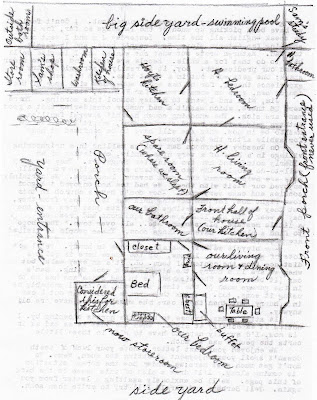
    Margaret drew a house plan to help her readers visualize their accommodations.

    Yesterday, Jim and I went shopping for Kathryn since Sam wasn't here, and it wasn't too bad. Kathryn wrote out what she wanted and I imagine we'll have to do that for awhile. People are kind and seem to understand our predicament.

    At this point I must insert a funny anecdote I recall. This is my version: Uncle Jim practiced the word he needed all the way to the store, and then forgot, so he said, with a very heavy American accent: "Quiero carne del animal que dice (I want meat from the animal that says), . . . (here he grunted like a pig)."

    Jim, Rita and I went to Sunday School this morning. The whooping cough has hit several families. Kathryn gets awfully bored staying home, and it's too bad she has to be in now, when she will have to be confined at home for awhile after the baby comes.

    The bicycle we have has already come in handy . . . the house here is quite a distance from the center of town. Oh, it's an easy walk, but when we're in a hurry, the bicycle is a good thing. Sam's car (it belongs to the mission) is in bad shape and has to be in the garage much of the time, so he'll probably use the bicycle some too . 

Sunday, August 13, 1950:

    It's so terribly dry. Yesterday was quite windy, and how it blew! I had chosen to do a big two-week washing. I had already started before the dust became so bad. We didn't hang any of it up until about 7:00 in the evening. By 10:30, most of it was dry enough . . . The Hoyts have a water tank fixed up so that water can be heated for washing. I guess we'll just use it since we may not be here too long. We're also using their tubs. I don't like to use their things too much, but they don't seem to mind.

    No baby yet! Kathryn is just going from one day to the next, expecting each day to be her last one here. I rather dread taking over. I won't mind the cooking but imagine the children will rather worry me. Of course, Sam will be here part of the time and will get them up in the morning. They never take naps, and she lets them go to sleep at night on the couch in the living room or in a chair there, and then puts them in their own beds when she and Sam go to bed. They won't go to sleep usually before 9:30 or 10:00.

    This week I had a nice beef roast which provided meat for about four meals. Then, guess what we had yesterday and today?  Otter. There's an otter farm near here. The Hoyts bought this one and gave us half for they wanted us to taste it. It's a mild meat, something like pork and yet it has somewhat of a wild taste like rabbit.

Saturday night, August 19, 1950:

    I went over tonight and asked the Hoyts over tomorrow for dinner. I feel sorry for them. The baby hasn't come yet, and naturally they are getting rather impatient. Sam has been staying at home all week, missing meetings, just to be sure to be here when the time came. And Kathryn, well I imagine she feels pretty uncomfortable; she says she has a hard time getting around. Tonight Lynn spilt all their milk all over the floor, so I took over our quart.  

     Dust, dust, dust! Did I tell you that last summer Argentina had the worst drought of its history; the corn crop was a failure, and this dry weather we're experiencing is just a continuation. Sam said there hasn't been any rain worth mentioning for a year. We have been told that cattle are dying for lack of pasture . . . 

    It was a holiday week, the 100 anniversary of the death of General José San Martín, the "George Washington" of Argentina . . .  On Thursday they had a program at the town's plaza and all the school children paraded, a bust of the General was unveiled, and someone made a speech.

    Another interesting news item is that the gypsies have come to town. Evidently it happens every so often . . . They have pitched about seven or eight raggedy tents on a vacant field near our house . . . They go around town trying to sell  pots and pans, trying to read your palms, asking for money and cigarettes . . .

    We have been trying to hear the news reports on the radio which Señor Carranza lent us. We can get them in English every night. It seems terrible to hear nothing but war reports.

P.S.: Monday noon

    Sam and Kathryn just left to "buy a baby" as they say here. Rita and Lynn are helping me with the dishes. We are all glad it's finally on the way.

Sunday, August 27, 1950:

    This is a very pleasant Sunday afternoon. We were tickled when the wind began to blow before dinner, for we had been out of water for a couple of days. I guess that is worse than the dust we get when the wind blows . . . Last night the moon was so pretty practically full. Jim and I stood in the galería (which is like a porch) and watched it for a little while. Sam doesn't think we'll have any more real cold weather.

     Kathryn and the baby came home yesterday afternoon. She seems quite well but I'm afraid she'll overdue. She says she feels quite strong, but the baby will just be a week old tomorrow. The baby is real cute . . . born last Monday afternoon at 3:20. At 1:30 on that day, Kathryn was sitting at our dinner table; they had already been to see the mid-wife and been told it would come between 2:00 and 3:00, so they left here about 1:45. I was glad Sam had a chance to eat before the ordeal; she didn't eat anything . . . Sam came back for us and we saw the baby when it was just an hour old. It was real cute even then, I thought.

    I did the cooking all week, and didn't mind it too much. Then we kept the children some--kept Lynn all day while Sam went to Río Cuarto to teach his Institute classes; he took Rita with him. We really enjoyed Lynn; he was quite good--went to bed without any trouble, which was a relief for me. He wouldn't take a nap in the afternoon, but I didn't lift him out of his bed, so he just sat there for an hour. He had a good rest anyway. He keeps us all amused with the things he says, and the way he says them . . . his eyes are a little crossed, but I believe he's about the cutest acting little boy I've ever seen.


    On Friday we kept them part of the afternoon and all evening; we all walked over to see Kathryn and the baby after supper. During the night Rita got sick , and still isn't feeling right. I surely hated for her to be that way when Kathryn came home. I felt we probably shouldn't have walked over to see Kathryn, it's a long walk, and Rita was pretty tired from having been at Río Cuarto all the day before.

    I enjoyed cooking in the Hoyt's kitchen because of having the oven to use. About every day I made a dessert in the oven--a lemon pudding, a peach upside down cake, a cottage pudding and a white cake for Kathryn when she got home. And today--ice cream! We made it in the Hoyt's freezer. You can't always get ice in the winter, but they were able to today. Sam really likes it. We used some very heavy whipping cream you can get here almost every week. Sam bought the Argentine meal they always get on Sunday for all of us, and we did enjoy it. 

    Life was now very full. So there are very few photos of baby Aldo. This earliest one is my favorite.   

Baby's bath time and adoring siblings

    Saturday night, December 10, 1950:

    Just think--Christmas only two weeks away! We have received more boxes . . . People surely have been good to us . . . We were so tickled with the Little Golden Books . . . sent for us to give to Rita and Lynn. They are so nice, and I know the children will just love them. They have so few books, and they look at them over and over again, and seem to enjoy them so much.

    Last Tuesday night Jim and I planned a wiener roast for the benefit of the two girls who were here teaching Bible School . . . I made ice cream for the occasion . . . Sam and Kathryn really seemed to enjoy it, and the girls too.

    Sunday, December 18, 1950:

    Sam has been helping Lynn Schrock hold a series of meetings in Río Cuarto. He went over Thursday morning and the meetings will last through next Saturday. It's kinda bad for him to be gone all the time for Kathryn really has her hands full with the three kids. However, he came home this morning in order to be here for the service tonight. Then I suppose he'll go back tomorrow.

    Did I tell you that I'm going to have the Schrocks and Hoyts over for Christmas dinner? 

    Monday, December 25, 1950:

    Well, our first Christmas in Argentina is almost over, and it was really very nice. I can't say that it seemed like Christmas though. I believe yesterday and today were the hottest days of my experience.

    But in spite of the weather, it was a nice day, and I'm glad I had the folks here. I think they all relaxed more than they have for a long, long time. Kathryn especially seemed to enjoy it and she deserves a rest. 

    After dinner, we sat around in our living room, talked, looked at pictures, sang carols, then opened some presents. Miss Nielsen brought something for everyone and then the Schrocks and Hoyts gave to the children of the other family. The five children were really very good all day. It surely is more fun at Christmas time to have children around. 

    Jim and I opened all our packages last night. My, what an assortment of gifts . . .one very pretty scarf I gave to Kathryn for it was just the right color for her read hair . . .We gave the Hoyts all something and they seem to really appreciate it so much, for they just couldn't afford to give each other too much. The children enjoyed their books so much, and Jim made a swing for them which they surely like.

    Wednesday, January 3, 1951:

    Sam and Lynn Schrock are conducting a tent meeting here this week. It means a meeting every night, beginning at 9:30, so usually it's 11:00 or 11:30 before we get home . . . Jim goes out every afternoon about 6:00 to use the loud speaking system all over town, advertising the meetings and playing gospel records. They stay out about 2 hours. Then we have a prayer meeting every afternoon to pray for the meetings. Then we have the whole Schrock family to cook for. They all came over Monday morning and will leave Thursday night after the meeting.

    This is Lynny Boy's birthday; he's three today. We went over after dinner to watch him blow out the candles . . . The kids are having a big time this week with Becky and Normy Schrock here.  

    We'll have to move in March, for they decided to have the Bible Institue here next year, instead of in Río Cuarto, and that will start in April. The Dowdys will be living here, and they will be returning from the States in March, so both the Hoyts and we will have to be moving before. The Hoyts are due for furlough, but have offered to stay for six more months, in order that there be someone in every town where we have a work established. 

    The Schrocks gave Rita and Lynn three rabbits for Christmas, real ones. The [wild] dogs got into the pen one night and ate one of them, and just the night before last they ate the other two. It's a shame they didn't have them fixed more securely, for Rita and Lynn enjoyed them so. 

    Friday, January 19. 1951:

    The missionaries had a short field council meeting the day we came back from camp, since all the men except Sam were going to be there in Río Cuarto. They wanted to decide whether the Hoyts stay an extra six months before going home on furlough. It seemed better to have them stay, and the Hoyts were willing, so guess they will. The Hoyts and the Maconaghys are both going to be moving to Río Cuarto around the last of March, and we will be moving to Corral de Bustos.

    Thus ends the narrative of daily life in the big house assembled from excerpts from Aunt Margaret's letters. There remains one memory of my very own that has stayed with me all these years. 


    I was out in the back patio alone. One of the men, who helped Dad a lot and faithfully attended the services, rode up on his bike. Innocently, I ran to the gate to welcome him. What he did and said next were weirdly strange to me, and wrong, I knew. So I ran!

    A few years ago when I was reading their old letters to Mother, I understood from my own experience what my parents had not comprehended in those early days. Dad wrote in their weekly letter of July 14, 1946:

    Yesterday we had something happen which was rather strange. We ate with the hired girl in the kitchen so that we could practice talking Spanish. In the course of the conversation she told us that about a year ago there used to be more folks come to the meetings . . .[one reason] because they do not like one of the believers--Señor C . . . 
    Then, at the women's meeting this afternoon as the  women were saying goodbye to each other, they say "Hasta luego" if they expect to see you again the same day. Mrs. Dowdy said "Hasta luego" to some of these women expecting to see them again at the regular meeting at night. But they said, "No, it's too cold." Then the truth came out , they said they didn't care to come to the services for there was a dog who regularly attended. They referred to this Señor C.

    Sometime after, I found similar references in the Marshall's letters a few years later. 

    I escaped the incident unharmed, mostly perplexed. My life carried on happily. I didn't tell my parents till much later and cannot remember how it came up. However, the memory never left me. 

    Now, in retrospect, I am sad to think of those he harmed with his corrupt behavior. I am sad for his wife and family. I am sad thinking of the naive new missionaries he deceived.

    Our world is full of such people consumed by unbridled passions, some even professing to follow Christ. I am deeply saddened by the fall of Christian leaders and the plight of their victims.

    Then I think of David in the Bible, "a man after God's own heart (Acts 13:22)." How is that possible when David committed adultery and then plotted to have Bathsheba's husband killed? He repented of his sin when confronted by the prophet Nathan. Psalm 51 expresses his deep repentance. Even though he was restored to fellowship and the joy of his salvation, he did suffer consequences throughout his lifetime--his son died, the one born from his union with Bathsheba; he was not allowed to build the temple because he had shed blood.

    I never knew what happened to Mr. C from La Carlota, but the Gospel message remains: Repent and be saved!    

Sunday, November 14, 2021

Moves

Last photo as a family of four


    My memory tells me we lived in two places during our time in La Carlota. My parents' letters had mentioned the need to move from the rented house attached to Dr. Gauna's office, but I didn't know when the move took place so I did some research looking for clues. 

    The background in these old photos told me we were still living on Gral. Paz 132 when I celebrated my fourth birthday, 1948.
        

    From the following pictures, I knew that we were there through the winter of 1949 and into early 1950 when Lynn turned two. 


    The new address was not published in the denominational magazine until the July 29th issue of The Brethren Missionary Herald. concluded that I must have been almost six years old when we moved into the doctor's large estate on Jorge Ross 631 sometime in the first half of 1950.


Jorge Ross 631, La Carlota

    In recent years, I acquired an additional source of information--Jim and Margaret Marshall's letters to their families. I am so grateful to "Aunt Margaret" for allowing me to see this treasured collection, a wonderful personal and historical record of their missionary life in Argentina. Their first impressions and early experiences upon arrival in Argentina, add much to the description of life in La Carlota in those days. 

    Margaret wrote on a bright winter afternoon, Sunday July 9, 1950:
It didn't seem very cold this morning when we awoke, but then every room where there is no heat feels pretty cold. Dust storms are common here in this land, and there was one in the air this morning. Most of the roads and streets are dirt and when it is dry, they are just covered with loose dust, and naturally when it is windy, it blows around. The folks say that sometimes in the summer time, the loose dust is so thick on the roads, a car gets stuck in it. Then when it rains, the mud is terrific, they say.

I'm so glad the winter is half over. We are getting more used to the cold and they keep two rooms pretty well heated here at the Hoyts, for which we are very thankful. Our bedroom and bathroom are quite cold.

Dorothy and Hill Maconaghy brought us here to the Hoyt's last Monday. Just before we were ready to leave Corral de Bustos, we received a telegram from the Hoyts saying that the little boy had whooping cough, but that we were welcome to come if we were not afraid. We hardly knew what to think, but I don't believe grown folks very often get the disease, and we were so anxious to get settled and to start studying the language that we came ahead. It seemed awful to impose ourselves on the family at such a time, but we are trying to help and not be any more bother than possible. We had hoped all our things would be here by now, but nothing but our personal effects have come yet; the barrels, cedar chest, bicycle, foot lockers, etc., came through from Buenos Aires the evening we got here, so we were glad we were here to take care of them. We can't unpack yet though for there is no place to put anything. On Tuesday we drove over to Río Cuarto with Sam Hoyt, visited the mission property there, met some more of the missionaries, and went shopping for some of our furniture. . .

The house here is very nice. Kathryn Hoyt has her five rooms fixed up so nicely. The floors are made of a nice wood, and how much warmer they seem than the cold, damp tile ones. Sam is very handy about making things, and he has made so many nice things, such as desks, kitchen cupboards; he is helping Jim with the cupboard for our kitchen. 

The Hoyts have two real cute children, a little girl six years old and a little boy just two and a half. They both have the whooping cough and of course it has been pretty hard on the little boy. It naturally worries Sam and Kathryn a lot. She is expecting another baby in a month, and Sam is very busy trying to be the pastor in four towns and teaching one day a week in the Bible Institute at Río Cuarto, so you can imagine that it is a rather hectic household and that we'll be glad when we can move into our four rooms. We'll have a nice big bathroom, and large bedroom and a combination living room and dining room and a little kitchen . . . This has once been a lovely place, but it's run down now quite a bit. There is a lot of yard, and many big trees. It seems as if we are right out in the country; I surely do like it. It will be so pretty in the summer time.

Well, we celebrated our first wedding anniversary on Thursday. It wasn't much of a celebration, but Kathryn baked a nice chocolate cake for us and put one candle on it. Then Dorothy and Hill sent us a telegram of congratulations.    


I have played the little organ [harmonium] for the two church services they have had in the little church here in town this week--for the prayer meeting on Thursday night and Sunday School this morning. Kathryn stayed with the children. Jim and I are going to sing a duet in Spanish for church this evening. We sang the same thing last Sunday in Corral de Bustos. It's not very good, but perhaps they enjoy it. Sam and Kathryn are good musicians, so know we won't compare with them. Sam has a very nice voice and plays two instruments besides.

    My brother and I loved "Uncle Jim and Aunt Margaret" (as we called them), and they were so welcoming! Once settled in their half of the fifteen-room house, we enjoyed going next door to visit them. Mother had to remind us often to not wear out our welcome. We tended to get in trouble for going over to their place.


    The Marshalls, on the other hand, seemed to delight in our company and were especially taken with Lynn. He was just barely three years old when Margaret wrote the following: 
February 16, 1951 
Lynn has just come in to say good-morning. I wish you could hear him talk. We surely get a kick out of it. He just talks and talks, so distinctly and with such expression in his voice. Then he's getting so that he can talk Spanish better and better, just as distinctly as he speaks English. He's better entertainment than a picture show. I'm afraid our own child will seem dull in comparison, but I don't suppose so.
Rita and Lynn taking turns riding with Uncle Jim


    Margaret wrote about Lynn again later:

March 7, 1951 
Lynn just ran out to go with Jim. He's been asking Jim all day to take him for a ride in the car; (we have the Ford [Model]A of the Schrocks while they are using the Hoyt's in Buenos Aires for a week or so; they had to make the trip to get passports for the children for going home.)
Lynn continues to amaze us with his abilities--he is such a character. He's been coming over to see us more lately, for Kathryn doesn't scold him so much about coming since she knows we won't be here much longer to enjoy him. He will come to the door and say, "I haven't seen you today" or "I want to come see you." If he sees something he'd like to have, he'll say, "I don't have one of these in my house," or "My mama didn't give me none of this." You just have to hear the expression of his voice to really appreciate what he says--his voice will go way up high and then down, and then up again. I guess you would say he just uses a lot of expression. He learns Bible verses quite easily, and knows a number of songs which we sing at church or which they sang in Bible School. This afternoon when he was over here, I was playing the organ, and he'd sing along with me. He usually has the tune just right too, and I think he has very good pitch for a child of three. This morning he was pumping up an inner tube with Jim's tire pump to play with--he got it pumped up too! Just this minute he opened the door and said, "Aunt Margaret, come. Ya lista?" Which means in Spanish, "Are you ready?" So I'll have to finish this later.
    I chose to include at this time, the anecdotes about Lynn and this early photo to honor the memory of  my first brother, who passed away November 13, 2017.

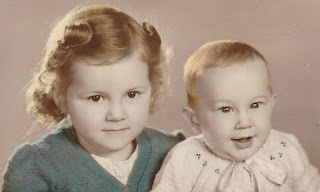
Earliest professional sibling photo
  

    Jim and Margaret lived in the same house with us for eight or nine months. Many changes were taking place about that time. It seemed that all of the missionaries were about to move: The Marshalls were to take over the work in Corral de Bustos and Maconaghys would replace the Schrocks in Río Cuarto when they left for furlough at the end of the month. Our family was also nearing the end of the first five-year missionary term and were asked to take Dr. Sickel's place in Almafuerte for the remaining months because he was very ill and needed a rest. The Dowdy's were due back from the US March 13 and were to oversee the Bible Institute in La Carlota. Two students, Horacio Bettinalio, and his younger sister Hebe, had come a month early to help out. Although only eighteen, he already helped out with the preaching.

    Moves are stressful at best, but to coordinate the movements of that many households had to be overwhelming. The transportation logistics alone were complicated. Add to that the uncertainties and unknowns involved in a relocation. My parents were still confused about the directive to move to Almafuerte, and troubled about leaving behind the work in progress, especially the construction begun on the temple.

    And there was a new baby in the household! The following announcement was published in the September 9, 1950, issue of The Herald:
In a letter to friends and relatives in this country, Rev. Solon W. Hoyt, missionary to Argentina, announces the birth of a son on August 21 at La Carlota. The youngster weighed 7½ pounds, and Daddy writes: "I believe we'll name our baby Aldo Elwyn . . . We like short names, uncommon names, and names that go well here and in the States."

     I tried to imagine what it was like for God's chosen people, the Israelites, during their forty years of wandering through the desert. When the cloud moved they had to pack up and march with their possessions and entire families, the old, the young, babies, toddlers, pregnant women. Yet God went before them, "These forty years the Lord your God has been with you. You have lacked nothing. (Deut.2:7)" "He spread a cloud for a covering, and fire to give light by night. (Ps. 105:39)" "Give thanks to the Lord, for he is good, . . .to him who led his people through the wilderness, for his steadfast love endures forever (Ps. 136 1,16)."

    So it was with my parents in their forty and more years spent in Argentina. God guided, taught and kept them. It is my desire to illuminate His faithfulness to our family through these writings.