 |
| Julio Reta, Roberto Fernández, Antonio Morales, Clyde Landrum |
It has been a great joy to see first-hand the Brethren work in Argentina!
It is good to see the vision of the missionaries and to talk with them of their plan eventually to place all of the work in the hands of the nationals. How wonderful to see the nationals working toward the same goal!
I remembered being so impressed with my father's thoughts on the subject in his earliest letters.
One thing which our mission has never believed before is that these people are able to support their own works, but all the evidence is to the contrary. . . Of course that's the way our mission began, and until brother Dowdy came down the idea has prevailed. . . According to the Word, I think we are depriving the people of a great blessing as well as curtailing our own work. (July 1, 1946)
The more I researched, the year 1962 struck me as very significant—the beginning of "Something New In Argentina." That was, in fact, the title of an article J. Paul Dowdy wrote for the Brethren Missionary Herald (July 7, 1962).
Most missions in the past have been opened and operated with the missionaries in charge assuming all of the responsibility and actually doing most of the work. The results have not been satisfactory . . . the most desired objective had not been achieved, that is, a locally supported, self administered, and self-propagating church.
For years in Argentina we have been struggling with the problems involved in the transfer of responsibilities from missionaries to Argentine Christians.
So, when a congregation takes complete charge of preaching services, Sunday school, and all of the other activities of a church program, that is something new, and is cause for rejoicing.
Brother Dowdy goes on to relate the story of how the second church in Río Cuarto began and became a completely Argentine Brethren church. The dedication service was planned and organized by the nationals; Horacio Bettinalio was the speaker. Although there was no ordained Argentine pastor available to take charge of the preaching, teachimg and administrative aspects of a church, these responsiblitities were assumed by the members. The new congregation was blessed with an unusually gifted group to carry on the work, among them several graduates of the Bible Institute.
While in Banda Norte the members of the congregation have taken complete charge of all the work of their church, in all of our Argentine churches capable members are taking a greater part in the activities and assuming more of the responsibility.
Dr. Landrum listed several areas where the transition from foreign mission to Argentine ownership was taking place.
 |
| One of many groups of campers over the years |
One of the finest examples of this is the camp work. From the beginning, the nationals have been in on planning for and carrying on the camp program. Today they own approximately two acres of land situatied at the foot of a mountain. On this beautiful site they have built permanent-type brick buildings . . . a girl's dormitory, a kitchen, and a combination dining room-auditorium, and nearing completion at the present time is a dormitory for boys. (12.08.1962)
 |
| Bible Institute students 1962 |
[Also] The Bible Institute is basic to the whole mission program in Argentina. . . It has literally transformed our Mission in that it has already supplied some of the workers and sent them out to pastor churches and to carry on the work in general.

 |
| Equipo evangelístico: Eduardo Coria, Juan Colle, Benjamín Enrici, Víctor Wagner |
The young men who held the meetings were graduates and current students of the Institute. Eduardo Coria (pastor of the Tancacha church) was in charge of the music. Benjamín Enrici, preached every night. Juan Colle, a chalk artist, used his talent to attract people, and then give a positive testimony of the power of the Gospel. Victor Wagner, current Bible Institute student and missionary candidate to the indigenous peoples in northern Argentina, was the general director and MC. (The Brethren Missionary Herald, 12.08,1962)
Brother Landrum was the main speaker for the Bible Institute commencement ceremony.
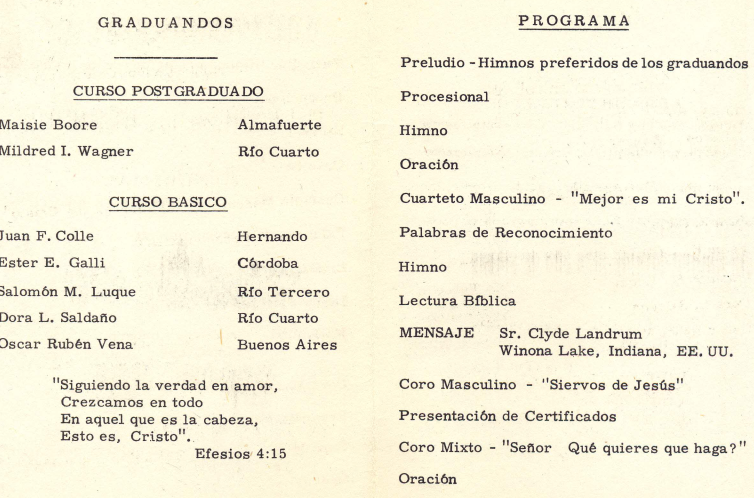
Dr. Clyde Landrum continued to report about "The Brethren Testimony in Argentina."
The work of the Mission in the inteior of Argnetina continues to be a blessing In addition to works that have been established over a longer period of years, a more recent work has been established in Córdoba, Argentina´s second largest city.
The headquarters church in Río Cuarto is now being pastored by a national, and the church has voted to fully support this pastor.
Interestingly, the pastor, Ricardo Wagner, was also Dr. Landrum's brother-in-law. Clyde's wife had an older sister, Laura Evangeline Larson, who went to Argentina as a missionary in 1931. Her first assignment was in Huinca Renancó where she met Ricardo. They were married in 1934.
 |
| Mr. & Mrs. Ricardo Wagner February 21, 1934 |
Thus it was a joy for Ruby to spend time in Río Cuarto with her sister and family while Clyde traveled around to the various mission points.
The report continues:
Also of great encouragment is the development of several churches in the Buenos Aires area. There is a semicircle of churches around the city, which has a population of over five million. The two beautiful new churches at Don Bosco and José Mármol are well established. The two-year-old work in Castelar is reaching souls in that residential suburb. A new work is now in process of being started in General Belgrano. The vision for the future is to complete the circle, and also to locate a work in the central Capital section of the city.
Dr. Landrum's list goes on to include: the radio ministry with hopes to expand and strengthen the follow-up work; the literature program with plans to find, train, and encourage writers as well as production and distribution.
In the plan there is to be a bookstore and reading room at Río Cuarto.The nationals are burdened for the Christian day school movement. They are hoping to get started on this program soon.
The Foreign Missionary Society had by then developed a statement on the Indigenous Church, which Dr. Landrum presented to the Field Council. Recognizing its progress in that direction, it was now time to move forward the program of ultimately turning the work over entirely to the nationals.
In a second article about his time in Latin Lands, Clyde wrote:
In my opinion, the biggest decision made by the Argentina Field Council, was to set up a plan of joint committees looking forward to the nationals ultimately assuming all responsibility for the work . . .They will work together throughout the year as one committee to do the work at hand, and once each year they will report back to the body appointing them . . . As the nationals assume more responsibility, financially and otherwise, they will have more representation on the joint committees, until the ultimate goal is reached when the nationals will carry the entire load. (Brethren Missionary Herald, 1.05.1963)
That is a summary of the big picture. What was happening in our little Don Bosco church? I can only speak from my point of view as one of the youth group increasingly involved in carrying the load of the local church and its evangelistic outreach.

The muchachos, the guys, worked a lot with Dad on various building projects. I'm not sure which one is pictured here. Perhaps it was the parsonage addition. Our family would be leaving in a year and the national pastor coming to take over would need a place to live.
The two Horas Felices (children's Bible clubs) were going strong Saturday and Sunday afternoons. However, it became evident that we had taken on too much. Our zeal was great, but the load was too heavy for some. This became evident when one day Milly broke down at school. She had not slept hardly the night before, it was her most difficult day and she had an exam. She was distraught, crying uncontrollably, so they called her family to come and get her. We realized then that something needed to change. I explained this to my friend Mirtha, in a July letter.
So after that, we divided into two well organized groups (thanks to Julio Poncet) and now we have both Bible clubs on Saturday afternoons. Emilia is the person in charge of planning and directing everything to do with the one in Don Bosco, and I am the "encargada" for Villa Domínico.
Roberto, Antonio, Lynn and a young girl about 12 or 13, Dorita Gómez, accompany Milly and I don´t really know what responsibilities each one has.
Mabel, Delia, Julio and Aldo go to Villa Domínico. Mabel and Delia are captains of the blue and red teams respectively, for the Interplanetary Rockets Contest we have going which has been such a blessing. Delia teaches the verse and Julio leads. Aldo holds the flannelgraph and I place the figures as I give the lesson. The assigned roles will change. We´re going to take turns teaching a series each. What happened was that we had already begun the Genesis series before dividing the group and no one wanted to take over and finish it. After it is over, the others will take their turn in the following order: Mabel, Delia, Julio. Each time the other roles will change also.
These are examples on the local level of young people taking ownership of the ministry. Transition to the Indigenous Church was happening. It was God´s doing. Jesus said, "I will build my church."
Fast forward to 2009 when the Grace Brethren Church in Argentina celebrated 100 years. The goal had been achieved! There were no more foreign missionaries, the church was totally indigenous!

I enjoy each new chapter, Thank you for taking the time to research and write. I believe the photo labeled "Bible institute students 1962" is most likely a photo from the 70's.
ReplyDeleteI don't know who you are, Anonymous, however, the photo appeared in that time frame in the BMH, and I recognize the students that would have been there at the time. Tell me who you recognize and why you think it was in the 70's.
Delete