Tuesday, May 31, 2022

Mirtha


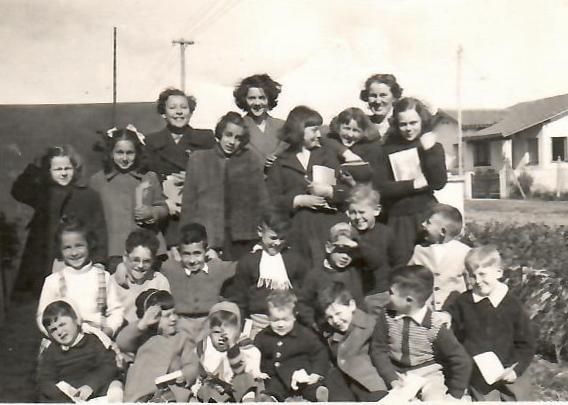
Among the visitors that stayed with us in Don Bosco, was the Siccardi family. Mirtha, their youngest daughter became my dearest friend. I believe this is the first photo of us together. She is on my left.
  
Mirtha and I  must have met when we were very small because our fathers were pastors in the same fellowship, but we did not see one another very often as our families lived in different provinces and only got together at summer camp and/or annual general conference.

This one time, however, Mirtha and her family came to Buenos Aires for medical reasons. 

Mirtha contracted polio as a baby.  As she grew into adolescence, her spinal column began to deteriorate and deviate rapidly endangering vital organs--lungs, heart and spinal cord. The reason for their visit to the capital was for a consultation with specialists at the British Hospital where her eldest sister Eunice was a nurse in training.

I cannot pinpoint the exact dates of their stay, however Mirtha remembers that it was at the start of the "Revolution", perhaps September of 1955. 

I found a prayer request in the denominational magazine about the time when she was hospitalized.
 
(Brethren Missionary Herald, 18.08.56)


The final decision of the medical team was that Mirtha had to spend five years of bed rest during that critical growth period. Her wise father discerned Mirtha's gift of writing and encouraged her to participate in a contest sponsored by L.E.A.L. (Literatura Evangélica para América latina). Her novel won third place! Moody Publishers won over several that would have published it. It was a bestseller.


Our correspondence began as early as 1954 when we were barely 9 and 11 years old. Mirtha carefully preserved all my correspondence in a large binder. I asked to borrow the collection. My brother and sister-in-law were serving in Argentina at the time and were able to bring it to the US and as promised I would send the letters back with them when they returned after their few months stateside. Then our housefire happened!

Amazingly, God protected those letters, they suffered minimal damage--some burnt edges and water marks, but still mostly readable. I was able to scan most of the letters before sending the binder back to Mirtha. Thus, it will remain another treasured resource to draw on as I write my life stories.


But now, allow me to go back and add to Mirtha's story. I found an article published in April of 1944 telling of little Mirtha's very serious case of infantile paralysis and God's intervention in answer to prayer. 


Mirtha is almost two years older than I. Our correspondence began when we were children. 

March 3, 1954

At camp that year there were three of us little girls that hung out together. We adopted the following nicknames: Ester was ovejita, I was pollito (little chicken), and Mirtha was conejito (little bunny). My next letter, July 28, was appropriately illustrated.


The last letter in the thick binder is dated May 1972. By then, I was married and living in Germany. In the intervening years, Mirtha became a literature professor and for twenty years was totally in charge of  a Christian magazine for children, El Puentecito. Sharing the gospel with the young generation has been her life-long passion.


This is an early sample, published shortly before Mirtha married Aldo Ferro.


In January of 1997, I was privileged to travel to Argentina and spend a few days in their home.


Last year, Mirtha lost her husband of more than thirty years. The following is my favorite photo of this dear couple.

Amazingly, God has kept her all these years to spread love and care to others. 
June 17th is Mirtha's 80th birthday. In her honor, here is a prayer of blessing.

The Lord bless you and keep you;
the Lord make his face shine on you
and be gracious to you;
the Lord turn his face toward you
and give you peace.

Saturday, May 14, 2022

1955


Casa Rosada and Plaza de Mayo


The new year in the southern hemisphere opens the series of summer events, such as vacation bible schools (if they were not held before Christmas), summer camps, annual conference (always during Carnaval), tent meetings. 

In January of 1955, two camp sessions took place in Las Albahacas, one for youth (4-12) and another for children (13-21). It appears that our family attended one of them.

Conference that year took place February 20-22. Mother wrote Sunday afternoon, February 27: 

Last Wednesday we got home from Río Cuarto. . . We had a very good conference this year, good spirit and good attendance. The Lord gave me liberty in giving my message and I thank Him for it.

I located a file folder labeled Mother's Messages and was pleasantly surprised to find the very message she gave to the women that year, confirmed by her handwritten note on the back, Río Cuarto- Conferencia 1955.


I learned more about the "unity of the Spirit" from reading this meditation, and about my mother's ways and her ministry contributions. There was a stack of 5" by 7" carefully typed double-sided 6 to 8 page typed message notes. On every one she had written on the back the location and date of delivery, and sometimes the number of people in attendance. Always the rounded corners as well, perhaps to fit exactly in her Bible.

Dad also gave a message. Mother wrote about it, 
Sam was to speak to the Young People's meeting which was from 4-6 in the afternoon. At 10 minutes of 6 they gave him the platform. He says at that time he didn't have too much desire to speak . . . the young man from La Carlota was in charge of the meeting and he just miscalculated and made the program too long. It was all very interesting even though a little long.

The letter continues,

This Monday Sam is going back to the interior for a tent meeting in La Carlota. Then the 15th we are expecting to begin one here in Don Basco. I trust we get all the necessary permissions if not I don't know if we can have them. Lynn Schrock is coming to help us. 

Thursday Sam went down to the Custom's house to get the packages. They would only let the one with the toys come through. 

These were probably the Christmas gifts that Grandma Hirschy mentioned in her diary. 

Tuesday, January 4, 1955 Took the trimmings off Christmas tree and wreaths and packed it all away. Daddy mailed 2 boxes to Argentina. 

Often getting things out of Custom's was difficult and costly, almost not worth the trouble. Yet the items that did get through brought joy. I remember reading the books and Sunday School papers that arrived over the years. One favorite series of children's books made a strong impression on me. I recently located and purchased a reprinted set of The Susie and Johnny Series.


Marshall's in their correspondence also mentioned the many trips to another town to pick up packages, and only being allowed to retrieve one, often sending the others back.

Mother continues in her letter, 
This next Thursday afternoon we plan to have our second women's meeting. There are lots of women who are willing to come to a meeting when their husbands are at work whereas they won't come to our other meetings.

Dad added a note: 

The work continues to go along very slowly. We often wonder if we'll have the courage to come back to this field . . . 

Forgot to mention that I had a tooth pulled which left a hole up into the facial cavity.

Then in the April 3rd letter, he said,

I've been visiting the dentist quite regularly this past week and have about three weeks ahead of me. I had 7 cavities and I still have the roots of a molar to be taken out. When a young dentist tried to pull it, he broke off the top leaving the roots. Now I have the same trouble that I had on the other side of my mouth - that hole which goes up into the cheek cavity . . . Kathryn needs to go to the eye doctor too. Aldo needs his tonsils out.

And among all the events of daily life, was my second trip to St. Cecilia's Conservatory of Music, and Lynn's first for our annual piano exam. Mother certainly made us look very spiffy. 


In the April 3rd letter, the day after Dad's 34th birthday, Mother wrote:

Fall is here and soon it will be winter. Yesterday we had a birthday but didn't do much celebrating. I wanted to make a cake but Sam wouldn't let me as he said I had too many other things to do. 

The 15th of March through the 24th we had our tent campaign. There were several decisions . . . Brother Schrock brought simple clear messages but it seems hearts are so hard. We had a lot of trouble this time in the care of the tent - pitched on a public plaza so all the boys of the neighborhood felt perfectly free to do what they wanted to. They threw potatoes, stones, clods, and even pieces of cement. Happily none of these things damaged the tent. However, the next to the last night they robbed two ropes. The fellow who takes care of the tent [don Pedro Olthoff] couldn't leave to eat with us except early in the morning for breakfast. The rest of the time we took his meals to him. 

On this earth we will not know the extent of the effect on those who heard the gospel that week in the tent, or outside, or by word of mouth. Dad wrote of an interesting encounter they had with a Jewish man, astronomy professor of the University of La Plata. He listened with considerable interest and respect. He said that he stood outside of the tent with his little boy. The next day the boy was singing "Libre estoy, libre estoy" (Free am I) and at first he didn't realize what it was, then remembered that it was the special music in the tent meeting the night before. 

 In the next few May letters, the need for a meeting place is evident.

May 1:  Last night we had a young people's meeting. There were 21 young folks in all. They seemed to have a very good time and have asked to have it every 2 weeks. . . The young folks from Mármol came also. We showed a filmstrip, "He Took My Whipping." Afterwards we served refreshments and they played games until 10:15. We always feel so handicapped for space. There we were just jammed in the living room. Fortunately it was a nice evening and not too cool so they could play outside, if not I just don't know what we would have done.

We've been looking around for lots but all of them are above 60,000 pesos and are so small. We've been wanting to buy a house with a nice lot beside it but the board doesn't have the money . . . . If we'd be able to get that, I'm sure the people here could build a temple on it and it would be such an asset to the work. The man has come down 25,000 pesos on the price he offered us first. It is a lot that is exceptionally large almost twice the depth of the others.

May 30: Next week we are going to have a council meeting in Río Cuarto and will be talking over the possibility of building here in Don Bosco . . . I confess I don't know what ought to be done - may the Lord give us wisdom. Our house is small and it is a private home which I'm sure keeps some from coming. 

May 10, the Marshalls left for their furlough in the US. Our family went to the airport to see them off. Lynn and I rode along with them in the Model A Ford, while Dad and Mother and Aldo went by train. We all came home in the car. Dad wrote: 

It was so nice to be able to come back so quickly and calmly. We're sorta tired of depending upon busses and trains. We have the Ford A now but I don't know for how long. Perhaps they'll leave it here for us.

However, Dad goes on to tell of a blessing that resulted from riding the bus.

About a month and a half ago a girl of about 19 began to attend our meetings as a result of meeting her on a bus. She has been very faithful and we have gotten to know her story a bit better these past couple days. She used to be in the Salvation Army. She was saved about 3 or 4 years ago and when she accepted the Lord she was asked to leave home. She went into the Salvation Army and became an officer. Due to ill health she had to leave that. Now she is living with her grandmother but . . . they don't get along too well. Last night her grandmother became angry with her and told her not to present herself for the meals today. So after Sunday School today she stayed with us. She is trying to secure a job but needs to know how to type . . . so she is going to come here to practice. For several Sundays now she has been teaching the little tots S.S. and Kathryn says she does real well. She also sang a special number for the young people's meeting and for the preaching service tonight.

Could she be the young woman next to Mother in this photograph labeled 1955? 

The same letter made reference to political unrest.
I suppose you have read some accounts of the recent political movements here in Argentina. For the past several weeks they have been publishing some of the most direct and clearest statements with regard to the catholic church in preparation for the separation of church and state. Now they have the separation and are changing the constitution in every point where this separation would affect it. And just in passing they are changing a few other things which will make it possible for them to make some treaty or agreement with foreign oil companies to come in and extract and refine petroleum. Perhaps this is really the big item they were after, but the separation of church and state is bound to bring betterment to the country. Last year the catholic church received 83,000,000 pesos from the national budget. To divert that sum into other channels ought to help some.

I did not understand what was going on at the time and do not even now grasp the full significance of what was taking place relatively close to where we lived. I do remember that from our home in Don Bosco we could hear the bombings.

Juan Perón had been president almost for as long as we had been in Argentina, and had experienced periods of unprecedented popularity. At this time, however, there was increasing discontent. 

June 16, 1955, in an attempt to murder the president, Argentine Naval Aviation and Air Force airplanes dropped 9 1/2 tons of ammunition on the Casa Rosada (House of Government) and its surroundings, killing 364 people, mostly civilians. Perón had been warned and was nearby in the Ministry of War. It was a very dark day in Argentine history. Perón was later ousted in a coup September 19, 1955.

In her diary entry of June 28, Grandma wrote: "Got letters from Kate & Sam. They are O.K. Sam walked thru the Plaza de Mayo the day before the shooting."

I have no more letters for 1955 after May 30. However, an excerpt from my grandparents' archives came to me.

December 1, 1955

We got a letter from Sam and Kathryn this week. They write, "Since we last wrote, we have been doing our share of making a stopping place for missionaries. We had the Dowdys with us November 10 through the 15. There were four of them and the first night we also had another lady from La Carlota, a Mrs. Marín. It was a pleasure to have her for she had attended the meetings all the time during our ministry in La Carlota. She was perhaps one of the most faithful to the meetings but we could never quite decide if she was really born again or not. She never prayed and we couldn't seem to talk to her on spiritual subjects without it being a monologue. Just a few weeks back she was baptized and a few months before she was truly born again. While talking with her one day I asked her why it was that we seemingly could never get close to her during our time in La Carlota. 'Well,' she said, 'I just wasn't one of the family yet.' 

As to the meetings here they are all going much better now . . . The S.S. continues to grow. There were 38 yesterday, and we just did not have seats for all of them. Please remember this in prayer. We need a building . . .

The Churchills arrived on the S.S. Argentina, November 13 at 9 a.m. They are staying at the Maconaghys right now and will be there until something definite is decided as to their location. 

Next Monday the 28, I go to Corral de Bustos for 10 days of meetings."

Godly perseverance kept my parents going in 1955 through the struggles of daily life and in the ministry.  And they we were protected amid political turmoil.

. . . for you know that the testing of your trust produces perseverance. 

But let perseverance do its complete work; 

so that you may be complete and whole, lacking in nothing.

James 1:3-4


Saturday, April 30, 2022

Friends


The deeper I dig into this project, the more I uncover--photos I missed, new outside resources, information that fills in or corrects what I've written previously. This blog format is like a first draft, should these stories ever become a published collection. For example, there was a discrepancy regarding the date of the first baptisms. In Dad's ten-year review of the work in Don Bosco, he wrote January of 1954. But as I read his letter to a supporting church written February 3, 1955, he stated that they took place, January 2, 1955. The latter date confirms what I remember, that I was 10 years old at the time I was baptized.

In that same letter:

We have been laboring in this field now for over two years. The message has gone out in the form of tracts from house to house, tent meetings, our regular weekly house meetings, and over the P.A. system from the top of our house. The average attendance for the first year was 17 and for the second, 18. In the Sunday School we saw a jump from 14 to 23. And the S.S. continues to run along nicely. There are quite a number of parents in this neighborhood who recognize the value of the S.S. for their children but do not consider that there is anything for them since it is in their minds just sort of a training in good, moral living.


This is a photo of one of the Sunday School groups of those early years. I am on the top far left, next to me is a dear friend, Delia Princic. If I remember correctly, she lived around the corner from us and we walked to school together. In any case, she attended Sunday School, we grew up together in the Don Bosco church, and shared many youth activities including leading children's Bible clubs, going to summer camp in the sierras of Córdoba, and so much more. Delia's father died of lung disease when he was 54. Her mother, Agustina was a believer and lived a very long life. Delia married a young man from one of our churches in the interior. They live in General Deheza, Córdoba. She loves music and learned to play the piano, organ or harmonium, whatever was available in the church. For years she was an accompanist. Her husband, Alberto Claro is a classical guitarist. 

As time goes on I hope to introduce each one of these my dearest friends. 

This blog also helps to reconnect with old friends. Since writing the last chapter I've had a delightful conversation and exchange with Mirta Fischer whose family was featured in that post. (She is next to Delia in the photo above.) Her experience growing up in the church in Don Bosco and her life story would make another wonderful chapter, if I could persuade her to write it.

Dad mentioned in his letter that during those summer months, Mother and I went to visit my schoolteacher. That is another distinct memory. In retrospect I think that the teacher in her affability toward me must have said something like, "I'll miss you this summer. Come and see me." I must have taken it quite literally. I remember insisting several times that my teacher wanted to see my and that we should go visit. Finally, Mother acquiesced, we took the bus to Quilmes, and appeared at her home. She was surprised! But we had a good conversation. I must have given her a Bible and she sounded interested in reading it.

In a later letter (April 3, 1955), Dad mentioned that our piano teacher and her husband attended the Sunday evening service in our home. And now I know her name, Mrs. Jones!

Both Lynn and I had just started school. I was back in the public school, but Lynn had a private tutor. He needed to see an eye doctor as he was having trouble focusing with his left eye.
In May I had a tonsillectomy in the British Hospital. That is another memory I have retained. Dad wrote:

Kathryn went with her and stayed most of the day. Then she went back the next day to bring her home. Everything went along just fine. . . she also had her adenoids out. I guess they were quite large and were causing most of her trouble. The operation cost 480 pesos which would be an equivalent of about 17 dollars at the present exchange.

Around that time, there were two Bible Institute graduates who were in nurses training at the British Hospital. They visited us often. I looked up to these beautiful girls and listened to all their fascinating stories and decided then that I wanted to be a nurse when I grew up. I am happy to say my life took a different path. I would not have made a very good nurse. However, these two remained very dear friends to our family throughout their lifetime--Eunice Siccardi and Hebe Bettinalio. Both led very interesting and fruitful lives.
Eunice was very involved in an international Christian nurses' organization.
Hebe had an unusual and fascinating love story. She married one of her patients, a British mariner! Their long-distance courtship spanned three years, kept alive by 300 or so beautiful love letters. They emigrated to the US where Ray attended Grace College and Seminary and became a pastor. Hebe got a degree in Counseling.

It is not surprising that Lynn mentioned them and many others in his handwritten memories.

My recollection of those years was the effect of music on me. Songs that I learned in those days are still engraved indelible in my memory. One song which always brought tears to my eyes was "God be with you til we meet again." We always used that as a send-off song for people who had been visiting and were returning to their homes.
Many very lovely friendships were formed at that time. I think of Hebe Bettinalio (Davis) and Eunice Siccardi, nursing students at the British hospital in B.A., César Cabral, who was in the year of mandatory military service, Nélida Zanetti one of the Bible Institute students who did an internship with us, Dora Saldaño (another nursing student) and many others throughout the years . . . 

There were always so many comings and going in our home: Bible Institute students who came to help with vacation Bible school; speakers for evangelistic meetings; Brethren young people who came to Buenos Aires to study; missionaries passing through or doing business in the capital, and visitors of all kinds. 

I don't know the occasion for the following photo, but recognize most in the group. Standing behind us three children are sisters Raquel and Hebe Bettinalio,  and Sara Siccardi. Rudy Fischer is on the right. I believe Raquel and Sara were training with Child Evangelism.


My father explains some of the difficulties in his ten-year summary. 

Not all the memories of the four years of the ministry in that house were pleasant. We cannot forget the times when because of the mud, no street lights, and no sidewalks, only a few attended the meetings, at times no one. Still my right hand was partly closed due to holding the knife so long after scraping the mud off the children's shoes as they came to Sunday School. Even brother Maccio will remember the night when he was walking very carefully so as to avoid the mud then suddenly slipped and his whole foot (not to mention his leg) sunk into the ditch. There was a time when the work was so discouraging that the pastor would have given up, and that is what he told brother Maccio. That discouragement spoke elocuently of the pastor's need for growth in his life. After exchanging ideas, we agreed to pray every morning at eight o'clock wherever we found ourselves, each one on our own until the Lord revealed His will about the matter. Not long after the Lord responded and thus the ministry entered a new phase.  [That is a subject for future chapters.]

Carlos Maccio worked with Child Evangelism in Argentina (LAPEN = Liga Argentina Pro Evangelización del Niño) and became a good friend to our family, a ministry partner. The Bible clubs he led faithfully in Don Bosco were very influential in the lives of so many, mine included. I remember the one that met in the garage of a Christian family from another church, a Danish family, the Clausens. They also became great encouragers to my pioneering missionary parents. I chose the opening photo to represent the truth of Hebrews 10:24-25. Mrs. Clausen and two of their children are pictured with our family and another little friend. Among their acts of friendship were the Sunday afternoon walks. They would show up and invite us to join them on a stroll of the area. What a wonderful way to share fellowship!

And let us consider how to stir up one another to love and good works, not neglecting to meet together, as is the habit of some, but encouraging one another, and all the more as you see the Day drawing near (Hebrews 10:24-25). 

Thursday, April 14, 2022

1954


Lynn (6 1/2) by gospel poster

At the very beginning of the work, in the year '54, we made a post with its corresponding frame for posters. Mrs. Fischer spent many hours preparing the posters we hung there. Only eternity will reveal the eternal results of sowing the gospel in this way. (Paragraph from Dad's farewell message to the Don Bosco congregation at the end of ten years.)

    I always admired Mrs. Fischer's art and now looking back even more as I recognize the time and dedication that went into this very creative way of sharing Bible messages. Each poster was an exquisite work of art. I wonder how many she made over the years and where they ended up afterward?

Mr. and Mrs. Fischer, Rudy and Mirta

     In another paragraph, Dad talks about an early milestone event.

In January of 1954 we had our first baptisms. We had a canvas pool made to use in a hole dug to the same measurements. Because they had a larger yard, and also because some from there asked to be baptized, the event was held at Maconaghy's place in José Mármol. So, among those baptized were Mr. and Mrs. Rodríguez, Mrs. Ravera and Rita Hoyt.   

Margarita, Camilo
& Graciela Rodríguez


First baptismal celebration in Mármol

    Hill and Dorothy Maconaghy were the second missionaries to settle in the Greater Buenos Aires. They settled in Mármol sometime after returning from furlough in August, 1953.  This was their third term of service. They first arrived in Argentina October 28, 1938.

    March 22, Dad wrote about another first and high point - the start of an evening class in our home on March 19. 
Last Friday night we had a very nice meeting here - it was our first Bible Institute class. There were 12 who came - some, in fact 4, I was not expecting. There are others I would like to get interested and see them come into the work as pastors later on. We're studying the doctrine of Salvation including the doctrines of grace, election, calling, faith, repentance, conversion, justification etc. Some of the boys want to extend the time to two hours weekly so I think we'll take up Bible Synthesis or the Analysis of some book. This means lots of work for me because I forget many of these details as fast as I study them. But it is good for me and helps in every way.

    Dad, always busy with his hands, also commented, 

Brother Maconaghy was here just a while ago to get some more of the chairs which we made for their meetings. In all we made 45 folding chairs - 20 for here and 25 for the Macs. They are quite a blessing for us because our quarters are so reduced that everything has to be folding. We'd like to have a set of book shelves . . . but we can't seem to find any place for the bookcase. 

    The missionaries in Buenos Aires often welcomed visitors from the interior: believers from other congregations; missionaries and pastors who came for fellowship or needing to do business in the capital; and any new arrivals from the US.

    March 31, we went as a family to meet a new missionary couple, Don and Hazel Bishop and little Gail. They sailed on the same ship we had come on, the S.S. Argentina. 

    Meanwhile, family dailiness and special events continued. March 23 I had my first annual piano exam which involved going with the teacher by train to the Conservatorio Santa Cecilia in the city, waiting my turn to enter the examination hall alone, playing my pieces from memory and waiting for the judges decision. Even though I had not been taking weekly piano lessons for an entire year, I was now in second year. The  teacher lived nearby, around the corner from our house. I wish I could remember her name. If I could ask Lynn, he would know. 

    May 17 Dad wrote a note that reveals little Lynn's exuberant nature, six years old at the time. 
Lynn began to study paino this morning. We are so satisfied with Rita's teacher that we thought we'd start Lynn also. He's just thrilled -as to whether he'll continue time will tell. He just couldn't wait to go for his class this morning. Ever since a little before 8 when he got up, he kept asking how soon he was supposed to go. Finally at 20 of 10 he went.

    Both of us had renewed our English studies following the Calvert Course. Mother tried to spend three hours helping me and one with Lynn. Afternoons, I attended the local elementary school, Escuela 42, and was in cuarto grado, equivalent to fifth grade because the so called first grade was spread out over two years as primero inferior and primero superior.

    Mother also sewed our clothes. Dad wrote, "Kathryn has been busy sewing a suit for Lynn, long pants for Aldo and a dress for Rita. Since we have been trying to get out some every afternoon to go from door to door, you can see how busy she has been."

    Mother was especially grateful when one of the many visitors, a trained seamstress, remade an old coat for her. Mrs. Rosetti was a dear friend from La Carlota,  converted during Dad and Mother's ministry there.

    For the second year, Mrs. McLeish, who had hosted us in her boarding house when we first arrived in Buenos Aires, invited my parents to sing and play for the elderly women in the Brittish American Home. They spoke and sang many songs in English and were invited to come back. Among the hymns was the one about the ninety and nine sheep. A few days later, little Aldo was coloring a picture of the shepherd who went out in the desert to find his one lost sheep. Mother wrote what happened next: 

He came to me and said "Mama, where in the song does it say about the little sheep out in the desert?" (He had heard his Daddy sing that song just the week before.) I got out the hymn book and read to him the hymn until we finished the phrase that says "Out in the desert He heard its cry--Sick and helpless, and ready to die." Then he said, "But, Mama, that makes me cry." He began to cry and until we cut the little lamb out and pasted it under the shepherd's arm he wasn't soothed. What tender hearts little ones have.

     I spent considerable time reading the letters my parents wrote to family and friends reporting on our life in 1954.  I also had an additional borrowed resource - Jim and Margaret Marshall's abundant correspondence - to help me understand life within the context of the Grace Brethren mission in Argentina back then when I was merely ten years old.

    As I read, I sensed a growing weariness and discouragement, almost to the breaking point. These servants persisted in doing missionary work as they knew it, faithfully sharing the gospel message at every opportunity, canvassing their towns more than once, engaging in meaningful conversations and relationships, yet so little fruit resulted. 

    Jim wrote in October of '53: "The work is so hard at times. People show so little interest in spiritual things. They take advantage of all we have to offer materially but aren't interested in forsaking their sins and living for Christ . . . they are tied to their superstitions and traditions."

    "So few folks come that one gets discouraged," wrote Jim on May 10 of '54. Once jokingly he said, "I just asked Margaret if she would have her nervous breakdown because if she could hold off while I have mine it might be better."  My father shared similar feelings, "Mr. Hoyt wrote that he is so discouraged that it is hard to prepare messages." For some time Jim seriously contemplated not returning to Argentina after their term was up.

    The dire spiritual conditions listed for Argentina in 1954 confirmed what I was learning. Here are a few:

  • Argentina was considered by mission boards to be the least fruitful mission field in the Western Hemisphere.
  • Spiritism was dominant in many cities and towns, with churches being unable to get a foothold in those communities.
  • The occult had a grip on millions, influencing every level of society. Christians frequented witch doctors for remedies to their sicknesses when they didn’t have the money for modern medicine.
  • Roman Catholicism, being the official state religion, discriminated severely against Protestant churches. Protestants were often forbidden to use radio and television, as well as to gain permission to conduct large evangelistic campaigns. 
    However, an unprecedented enormous event took place that year which “broke the back of the rigid Argentine resistance to the evangelical witness” (according to missiologist and statistician Arno Enns).

    Dad and Jim both made mention of Thomas Hicks' campaign in their letters. Their comments aroused my curiosity so I did some research. I found the story of American Healing Evangelist Tommy Hicks (1909 – 1973) fascinating.
    In 1952, he was not very well known yet. God impressed him with the image of South America as a wheat field ready for harvest. He kept this to himself but wrote in his Bible prophetic words to the effect that after two winters he would go to that country, not by boat, nor by land, but as a bird flies. Three months later, God's word was confirmed to him when someone he did not know, repeated those very poetic and prophetic words in her prayer.
    A group of Pentecostal and Alliance pastors were organizing an evangelistic campaign in Buenos Aires in 1954. The chosen evangelist had to decline, so Hicks was invited to take his place. 
    At the Los Angeles airport, he and his friends prayed for a harvest of 50,000 souls. During the flight, a name was on his mind. He asked the flight attendant if she knew anyone by the name Peron. She informed him that Juan Perón was the president of Argentina. When he met with the evangelism committee organizing the campaign, he informed them of two prerequisites: he must have a meeting with President Juan Perón, and he must have a stadium that could hold at least 25,000 people.
    The organizing committee considered these suggestions preposterous, absurd, and impossible. 
In obedience to God's directive, Hicks went with his interpreter to the Casa Rosada (office of the president), and met with the Minister of Religion. When all seemed lost, the minister's secretary came limping into the room. Hicks asked if he could pray for him, to which the man replied, "If Jesus Christ were here himself, he couldn't heal this leg." However, Tom prayed, the man was instantly healed, and Hicks was invited to come back the next day for an audience with the president.

President Juan Perón


Tommy Hicks and Argentine President Juan Perón

    When he was ushered into the presence of the feared leader, he explained that he wanted to conduct a salvation-healing campaign in a large stadium, with press and radio coverage. President Perón was suffering from a persistent skin disease so noticeable that he no longer allowed photographs. Tommy Hicks prayed for him and the power of God immediately healed Perón’s skin condition.
So it was that all Tommy's requests were granted:

  1. Use of the 45,000 seat Atlantic Stadium
  2. Free access to state radio and press
  3. Freedom to preach anywhere they wanted.
    The services began April 14 with only 6,000 in attendance. For fifty two days the Gospel was preached every night followed by prayers for healing. The crowds filled the stadium and overflowed into the surrounding blocks so the campaign was moved May 22 to Huracán stadium with a much larger capacity. Thousands of Bibles and New Testaments were sold.

The Christian Brethren denomination continued to grow, even though they had mixed feelings about the theological leanings of Tommy Hicks. Decades later, Argentina is still reaping the benefits of the outpouring of His Spirit in 1954. (1954 Argentina Revival)

    Every great revival is preceeded by extraordinay prayer. The 1949 Argentina Revival was the spark that prepared the way. 

    God in His meticulous sovereignty had led Jim Marshall, in charge of programming, to choose Revival as the theme for camp that year.

Call to Me, and I will answer you, and show you great and mighty things, which you do not know. (Jeremiah 33:3 NKJV)

Thursday, March 31, 2022

1953


Buenos Aires, Plaza Congreso


What in the world was going on in 1953?

World leaders were rearranged. 
  • The Shah was reinstated in Iran. 
  • The Korean War ends after three years and one month and the loss of over 1.5 million lives. 
  • Stalin died after a twenty-nine year Russian rule, responsible for the death of millions. Khruschkev began his de-Stalinization program.
  • Cambodia declared independence from France after a ninety-year colonial rule. 
  • In the US, Eisenhower began his two-term presidency after a very successful military career. He was a five-star general during WWII and became Supreme Commander of the Allied Forces. As president he was credited with, among other things, with creating the U.S. Interstate Highway System, and NASA. 
  • In the UK, Queen Elizabeth II's coronation on June 2 was the first ever to be broadcast on television. Interestingly, that same year the first color television sets became available for about $1,175 in the US!

Among other achievements:
  • Albert Schweitzer received the Nobel Peace Prize.
  • Sir Edmund Hillary and Tenzing Norgay conquered Mount Everest, the highest peak in the world.
  • British physicist Francis Crick and American biologist James Watson discovered the double-helix structure of human DNA.
Meanwhile, what was happening in our little corner of Argentina?

    In September of 1952, our family moved into a house in Don Bosco. Some time in October, our dear missionary friends, Jim and Margaret Marshall and 15-month-old Michael, visited from Corral de Bustos. It appears that by then Daddy had built a swing for us.


    Among my father's papers I found seven tattered type-written pages, a summary story shared with the congregation as a farewell. I will allow his words to describe those very early days by translating for you the pertinent sections. Some of the the following may sound repetitive if you've read the previous chapters. 


Review of the Brethren Church in Don Bosco
1952 - 1963
    A young couple about thirty-years-old with three children and five suitcases is seen arriving at the Retiro train station. How lost they felt among the multitude in this new world! Their destination was the boarding house of a friend in Quilmes, but how to get there? How to buy tickets? How carry the suitcases along with three children? Such problems filled their minds. After many inquiries, they arrived at the Constitución railroad station. They asked more questions, moved their children and suitcases toward the train line which would take them to Quilmes. Impossible to hide their bewilderment, they were assisted by a fellow traveler.
    Once settled in the boarding house near the courthouse in Quilmes, we began looking for a more permanent base from where we could ascertain the best place to establish a testimony for Christ. For a family with small children, the wait was long - we were piled into a room for one and not for five. Such was our impatience that we almost rented an apartment in an area that already had a testimony. But, the Lord stopped us and in His time provided a house in Don Bosco. The 23 of September of 1952 we were able to bring our furniture from Río Cuarto and move into the house.
    In a short time we recognized our inability to wisely evaluate the immense mission field that is the Great Buenos Aires. Our lack of experience both in life and missionary work made this task impossible. In addition, we saw the possibility and the need to start a Sunday School in our own home. So it was that in the month of October we celebrated the first Sunday School gathering with three children present outside of our own family--Arnaldo Calderoni, Julio Reta and Silvia Reta. If I remember correctly, they were the only ones invited, as they were our children's playmates. So, the first meeting was 100% successful. We have not experienced similar success since that day. 
During the months of October and November we were dedicated to house-to-house visitation and the Sunday School. Those months seemed endless because we were eager to see the first fruits as soon as the seed was sown, but it was necessary to wait a little more. 
The First Big Scale Effort 
    In the first days of December, this peaceful town was surprised by the appearance of a comical truck from the year '29 known as the Bible Coach. It took 30 hours to make the trip from Río Cuarto to Buenos Aires bringing the tent; all the equipment for the first evangelistic campaign; don Pedro, the caretaker; and two fellows from the Bible Institute. It might be amazing for some of you to know that the tent was raised on the same site where you are seated now. It was truly a conquest to set it up; so many tall weeds had to be cut down and after that we had to hire the Italian with his cart to carry it all away, not only the weeds but also shoes, wire, a cat and dead fish.
Four Years in the Pastor's House 
    Now we entered into a new phase of the work - meetings in our home. This continued until December of '56. En the last meeting of the campaign we announced that the tent was leaving but that meetings would continue the same in the Pastor's house - Calle 31 # 33. The first meeting was held on Christmas Eve. At that time we were 27, a greater number than we expected. The attendance varied throughout those four years, but especially blessed were the Daily Vacation Bible Schools for children with an average attendance between 23 and 27.
    Two more tent campaigns were held - one on the corner of Cramer and Ramos Mejía and the other in the plaza on the other side of town, the current location of the new first aid clinic. None of these campaigns had the same welcome nor such good results as the first. However, the Word was sown and at least one person made a profession of faith and has remained.

    The Vacation Bible School reported in the Herald, must have taken place some time during the summer before Grandpa Norman's brief visit toward the end of summer.  
Don Bosco (Buenos Aires), Argentina

A report has just come in from Bro. Solon Hoyt concerning their recent D.V.B.S. "We just finished a daily vacation Bible school here. I believe the average attendance was 24, which we consider good for a new work. Wednesday evening we having the program when we hope to get the parents out.

We are constantly encouraged, although we are not seeing mushroom growth in our work. There seems to be steady, consistent attendance. Last Sunday night there were 26 of us.(Brethren Missionary Herald, 5.02.53)

    Other summer events had to do with the entire Grace Brethren fellowship in Argentina: camps and annual conference. Considering that we now lived a long distance from Córdoba, the mission hub, and had to use public transport, I can't imagine how our family was able to fit all of these travels into the short summer before Grandpa came. But the photos labeled Jan. '53 confirm that we were at youth camp.

Camp site


Transportation

Workers
    Mother and little Aldo are between doña Elena, the cook, and the Wagners, don Ricardo and doña Laura (based in General Cabrera). Next to the right: Lynn Schrock from Río Cuarto; don Pedro, the faithful caretaker, man-of-all-trades; and finally Bertha Abel, single missionary also in Río Cuarto. 

Kitchen crew


Campers and extras, like me sitting in middle front

     In March, soon after Grandpa's visit, the school year began. I am not sure when I started; it may have been later. In any case, it certainly felt like I was jumping into the middle of somthing I did not understand. During the one year in the US, I had lost language fluency. I don't know how much Spanish I had regained by the time I entered school in the third grade. Somehow, I survived and even thrived. 

    For those who may not know, the starched white school uniform is called guardapolvo, which literally means "keeps off dust" and is a mother's nightmare to keep clean.


    In August, Aldo turned three-years-old. Early in the year he had an accident where he broke his arm and it was either not set correctly or was impossible to avoid the unnatural double-pointed elbow. 


    Sadly, later in the year, he suffered another misfortune. The two brothers were handling the push lawn mower, and Aldo fell on it. A note in Grandma Hirschy's diary says:
Tuesday, November 3, 1953 
Had a letter from Kathryn. Aldo got his index finger cut off in lawn mower.
    As I reconnect with people we met in Don Bosco those seventy years ago, I hear interesting stories. Graciela Rodríguez was Aldo's age and grew very close to our family. She recently shared one vivid memory of those times. She saw Pastor Hoyt with Aldo in arms running madly past their house on the way to the clinic. Which accident? Perhaps both. Thankfully, Aldo let nothing keep him from enjoying all the opportunities life has given him.

    My parents also never allowed hardships and challenges to slow them down or cease to praise God.   
    "Blessed be the Lord who daily carries us. God is our deliverer (Psalm 68:19 ISV)."