Friday, March 31, 2023

1963


My last year in Argentina was difficult on many levels—school, relationships, church. 
My friend Mirtha, far away, felt something in her spirit, and wrote:
Manita, [little sister] is something special happening to you that I have such a desire to see you or are these just my "feelings"? . . . You know, I feel such a need to pray for you.

Comforted and encouraged, I responded:

The Lord is so wonderful! To think that He told you that I needed your prayers, that something serious was happening to me . . . I felt that I was drowning in a hole of desperation, discouragement, and sadness. . . I was failing in everything. I was not doing well in school, practice teaching, and other subjects. I felt useless. 

A dear friend nearby, also felt the need to pray much for me. 

Not long after, I experienced a different attitude, a new outlook on life. My joy returned, even though the demands of life did not lessen. 

It was my last year of high school; the load was very heavy. I explained to my friend how terrible the academic pressures were with new trimester exams, and professors expected to cover more material. 

. . . you know, so many times this year I wanted to quit school completely, throw away my books to never see them again. 

However, Mirtha, I assure you that the Lord gives me so much strength physically and spiritually and helps me so much. If it were not so, I don't know what would happen.   

 At that time in Argentina, Normal school was a five-year program that prepared us to become elementary teachers. The last two years focused on education courses including practice teaching. I found lesson planning especially challenging and spent an inordinate amount of time in preparation. Eventually, to my surprise and that of my professors, when I was teaching in the classroom, I thrived.

The schedule was so tight, so little leisure time, not much sleep, I longed for breaks or holidays. When Pope John XXIII died (June 3, 1963),  as an immature teen, instead of mourning "The Good Pope" (Il Papa Buono), I rejoiced to have a day off. 

Again, in November we had a national day of mourning, surprisingly it was for the death of President J. F. Kennedy. His assassination shocked the world. It is one of those events that became etched in the memory. I remember when Mr. Gammel, our next-door neighbor called over the fence to give us the news.

This is an aside, but there is another interesting anecdote involving the Gammels, our elderly German neighbors. They had lost a young daughter many long years ago. When they were ready to part with her beautiful doll, they gifted it to me in a generous and ceremonious way. It was large and beautiful. Sadly, I was beyond the age of playing with dolls and did not grasp the significance of what they had bestowed. I never knew much about their great loss. (I wonder what became of the doll.)

Meanwhile, family life was very full.

 I wrote to my friend about 
Baby Alan:

. . . the most beautiful boy in the world, is so chubby. He has blue eyes, hair like my mother's . . . he laughs so much; this morning in Sunday School we could not keep him quiet.  

Ivan is so happy with his little brother . . . not at all jealous. The only thing is that he's a little bit rough or not as gentle as he should be and usually has dirty hands, so we don't let him touch Alan. 

I could so easily get distracted enjoying my little brothers.

I got back at 5 p.m. from practice teaching. I looked after Alan for a while, then I spent some time with Ivan teaching him some letters. 

Later in the letter, I chided myself for ¨wasting time.¨  I'd tried to prepare a lesson plan that evening but had to get up at 3:30 a.m. to finish it.

More family details appear in Dad's letter to my grandparents.

April 27—This night is a lovely time to be home. It is raining and has been gray all afternoon and part of the morning. We just finished supper: Kathryn and Rita are doing the dishes, Lynn is studying, Aldo is entertaining himself near Lynn, and Ivan is bothering both of them. Alan just finished taking his bottle and was doing some superb smiling for Rita. He is truly the prize of the household. He has been so good and is so nice and fat. We wish you all could see him. Well, it won't be too long. The months are rolling around so fast that I wonder if we'll finish all we should before our time of departure.


This past week we finished uniting the roofs of the streetcars we have in Quilmes. We must finish one wall, repair the floor a bit, and set up the rest of the benches and then we will at least be temporarily done with those two streetcars. Then we must go to the second annex and join the two we have there in Villa Domínico. After that I should finish the prsonage we started back in February. The Happy Hours we have in the two locations have been going very well up to now. 


I recounted for Mirtha a humorous experience when my Bible Club group had an unusual visitor before we had begun using the streetcars. 
. . .we had 24 children and a drunk. Poor guy! He behaved quite well considering his condition. He sat on the grass in the back like a kid. He arrived about the time I was to teach the verse. I had not noticed that he was drunk. I began saying something about the text and with a nasal twang, he said "The first text that came into Argentina was the textile with a double 's'." I was so surprised that I stopped and looked at him but Julio motioned me to keep going. So I paid no more attention to him and he behaved quite well. Sometimes he would say something crazy and the kids would turn around and laugh; he laughed along with them.

The verse was John 15:13 and every time we said John 15:13, he laughed. He said "lay down your life for your friends. . . is okay. . . but. . . John 15:13 Ha! Ha!!!"

 Throughout the lesson, he listened like a child and repeated many words that Mabel was using, but really was not very disruptive. When the kids turned around, he would say: "Pay attention . . . this is good . . . to hear it . . . and aristrocratic to feel it." And sometimes he would call on one kid especially: "Pelopincho ¡Pelopincho! Pay attention!" 

At the end, when Mabel was giving the plan of salvation, he interrupted to ask: "Who decides the evil of destiny? Who is the promoter?" Mabel did not understand and didn't know what to say, but went on: "We are all sinners and the only one who can save us is Jesus." The man said in a strange and low voice: "Thank you, Miss." Later, "Pardon me for interrumpting . . . with an indiscreet question . . . I wanted to know . . . I like this . . . I love God, and Jesus, and all." 

When Ricardo greeted him he said: "Thank you very much. The greeting is yours cordial and always."

This last phrase we repeated so often among ourselves that it will surely go down in history. 


In the family letter dated June 10, Grandma wrote: 
We had such a nice letter from Lynn last week and I wish I could copy the whole letter but, time and space does not permit, we surely appreciated it. Some quotes: "Daddy was in bed sick two days because of his back. Mommy is very happy about Alan most of the time but sometimes she is not so happy because he spits up a lot. She misses you quite a bit. In fact we all do."

The truth was that Mother was very conflicted at this time. The news about Grandpa Hirschy's declining health troubled her deeply. Should she try to fly to the US to see him? But how could she leave the family during this intensely busy time, and with a baby? Would Grandpa get to see his namesake? Grandma had expressed her heartfelt wish that we would be able to travel back to the US before it was too late. However, that was not to be. The cancer, detected in the spring, continued to spread and he died August 25, three days after they celebrated their 50th anniversary. 


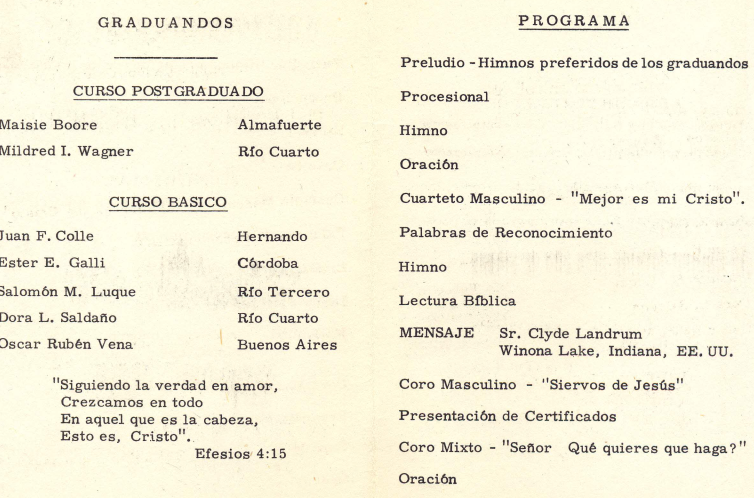
The school year ended in November, and despite the many trials and travails, I graduated!

Graduation ceremony


My graduating class

Then began the trámites, the red tape and paperwork hassles in order to leave the country. I wrote some of these details to Mirtha.
Friday, December 13, 1963 

Here I am downtown Buenos Aires, in the car at a mechanic shop. Straight ahead I see the Ministry of Communications at the left and the Luna Park at its side on the right. . . If I look behind I see the Casa Rosada [government building] and I just saw Illía looking out the window (Ha! Ha!)  [Now I know who won the election July 7!]  I´m here alone with Ivan. Dad went to do things while they fix the car which stopped working suddently here in the Capital (luckily in front of the mechanic shop). 

This is the fourth day we´ve come to the Capital. I´m so tired of buildings, buildings and more buildings. 

Tuesday we came by car. It was raining, and raining, and raining. We went to the Police. Lynn, Aldo and Alan, Argentines, got their passports. Dad got his travel certificate. Mom had hers already. I needed to get one, but when I presented my identity card and they saw that it was issued in the province, they said it would not do, that I needed one issued in the Capital. And we found out that Ivan could not leave the country without an identity card. So both of us needed to obtain one. For that we needed: 1) Certificate of Entry into the Country, and 2) Certificate of Nationality.

To obtain the first we went to the Migration Office. For me there was hardly any problem because I was already registered and I had been there other times, except that it would be ready for the 18th and we were due to leave on the 20th. We had to talk to the chief and ask for a favor. 

However, little Ivan had not been registered, I don't know how that happened, but, of course they could not give him an Entry Certificate if they did not even know he existed! They asked for a birth certificate, we did not have one (only something that was not the same and was not acceptable). They asked for another document . . . Well, we had done enough for one day so we left for home, but . . . it was raining, and raining, and raining!!! The streets were like rivers, sidewalks covered with water, many stores closed because the water reached their doors or even went inside. . . Mitre Ave. which we necessarily had to take to get home, was worse. Twice the car stalled as the water was too high and we had to pay 200 pesos each time for a horse to pull us out (its owner was very happy that day!)

The next day Dad, Ivan and I went into the city, but this time by train, subway, on foot, etc.. So for two days we were walking and walking, waiting, and waiting in one office or another and each time there was something new.

Yesterday, for example, we went to the Ministry of Foreign Affairs to legalize three documents we obtained from the American Consulate: certificates of nationality, one for me and two for Ivan (one for the Police and another for Migrations).  

 Amazingly, everything came together for our timely departure, December 20, 1963.

Angel Camandona, the new pastor, nicknamed Pachín, arrived one week earlier.

Pastor Pachín in front of the parsonage

Margaret Marshall wrote about their experience of the memorable farewell.
Dec. 20

Friday night we all went to the airport to see the Hoyts off. Their plane was supposed to leave at 7:30, and it was almost 10:30 when it finally left. . . There were several folks from our other churches there.


Some of the farewell crowd

Looking back, by way of reflection over what God had done, I shared with Mirtha, in the above-mentioned letter:
I always remember a church meeting we had over a year ago, there was heated discussion and it was truly historic. There we spoke of the need for a pastor after we left. Everyone was in agreement. Then we talked about the need to provide him with a place to live. There again everyone was agreed. After that we discussed the need for a meeting place in Villa Domínico, not only for the Bible Club but especially to begin working with the adults. On this matter there were differing opinions: some felt the need was urgent and others said we should first build the parsonage and then think about Villa Domínico . . . Julio was of this opinion . . . This led us to pray from that day on for a pastor, a parsonage and a place in Villa Domínico. And the Lord gave us all three, and as if that were not enough He opened one more annex.
Thus ended my life in Argentina. My parents and three brothers returned. The family passport photo (that opens this chapter) had Rita and Lynn's faces crossed out and also indicated our cancellation on a separate page. My brother and I were beginning a new chapter of life. This is the end of Part One. As an addendum, one more entry summarizes and describes a significant relationship that cannot be forgotten.

Now to him who is able to do far more abundantly than all that we ask or think, 
according to the power at work within us, 
to him be glory in the church and in Christ Jesus throughout all generations,
forever and ever.
Amen.

Ephesians 3:20-21


Tuesday, March 14, 2023

Summer of 1963


Youth Camp Choir

Summer months were usually full, but this year seemed to be exceptionally so.
After sixty years, I had forgotten many of the happenings that I find in the letters and documents gathered from various sources. 
Here is one interesting seasonal tidbit I related to my friend Mirtha:
January 8, 1963

This morning I got up at 5:45 to go with Lynn to the town fair. [Every Tuesday vendors set up their stands across from the train station.] He has a stand there with Bibles, Christian books, and Alpha radios [the business of the three friends, Julio, Roberto, and Antonio]. The street fair is a block away from the Temple, so someone always needs to help him carry and set up the table. His little stand has drawn quite a bit of attention and he has sold 3 or 4 or 5 Bibles, 2 of your books, several books for children, 2 or 3 New Testaments, etc. Lynn is so excited about this work that his life is centered around it (well, maybe not that much, but almost).

As more Brethren churches were added in the Greater Buenos Aires, the cooperation and joint events increased.
 
January 5 all the youth groups met in Castelar where Don and Hazel Bishop had settled two years earlier.

Jim and Margaret Marshall had moved to Ciudad General Belgrano at the end of 1962. Dad made numerous trips to their place throughout the summer to help them settle into their house and build a garage. Often he was accompanied by members of our family and on a few occasions took along a couple of the young fellows that regularly worked with him on a variety of projects.
 
Meanwhile the Marshalls had been reaching out to their neighbors. Sunday March 3, they began services in their home.

Early January, Jim traveled with thirteen children from the Buenos Aires churches to camp in the sierras of Córdoba. He stayed to help with the other camp sessions. This year Dad did not participate at all in the camp programs as Mother was due to have number five sometime before the end of the summer. 

We had a record number of youth that attended camp from the Buenos Aires area, some 35. I was very excited that Delia, my classmate, and her sister were among them. They were especially enticed by the fact that they would be able to meet our author friend Mirtha Siccardi, whose novel they all read including their mother. 


Also it was my last year. I wrote to my friend, "Did you realize, dear Mirtha, that this is the last camp before I leave for North America and it may be the last time I see you before leaving because I don´t know whether I will be able to attend Conference?" 

I remember feeling very sad many times during that camp.


The description of our return trip from camp brings back those happy sad memories. The two and half hour ride in the back of the truck from the sierras to the city of Río Cuarto left us filthy, covered in dust and very tired, but happy. After washing up, a bite to eat, a little nap, some of us went to see the sights: the lovely city park with boat rides, and then downtown for food and souvenirs. I almost didn't go as I had been crying, feeling sad again. That night we took the overnight bus to Buenos Aires, my last time.
I slept a lot on the trip but even so we arrived very, very tired. It was good to be home again and see everyone. I found Mom well, except that her feet were quite swollen. After cleaning up and a bite to eat, I went to sleep. At 4:15 Dad woke me up; it was time to go to the Temple to leave for Bible Clubs.

In an earlier letter to my friend I had mentioned an interesting new development surrounding the children´s Bible clubs.

Did you know that we asked to be given streetcars? I don´t know if you heard that the government is giving away streetcars to any religious or charitable organization. LAPEN [Child Evangelism in Argentina] through Mr. Bongarrá obtained 10 and he himself also several. Dad, before knowing this had requested some and we are praying that they will give us at least one to place in Villa Domínico.

So, what did happen? I remember that my mother was the one who saw the ad about the government giving away old street cars and suggested they could be used as little chapels in these outreach locations.

March 5, Mother began a letter to her parents:

Here Rita and I are sitting in a street car trying to write letters, read and rest, but we aren't able to do much of anything as there is a gang of kids outside trying to bother. Yesterday morning we hired two trucks and a truck with a crane to bring the 4 streetcars. (Did we tell you that the Government gave us 4?) Two of them we placed on a lot in Villa Domínico and two here on a lot that belongs to a believers´ family. Daddy and some of the men are putting a wire fence around the lot in Villa Domínico and probably tomorrow they will do it here, that is if I don´t pull any tricks and go to the hospital. I´m so glad I´ve been able to keep going yet. 

Last night Lynn and another boy slept in the one in Villa Domínico and two others here. This morning when we went to see how they fared, all had passed the night very well and peacefully.

These streetcars are really useful. One is a 1955 model and in excellent condition. The other 3 have a seat loose here and there or a few windows broken but they all can be fixed in time, and make nice little chapels. Each one has seats for 36 people.

The hard work began in earnest. Men, young and old, began taking out the middle walls to join the cars, then join the roofs, and do the repairs. 


 Dad picked up writing where Mom had left off. 

Thursday A.M.

These are difficult days - we are trying to do too many things in too short a time. We´re trying to do our best to protect these streetcars, but after we´ve done all we can, the Lord can take care of them. . . Since the young people have been having Bible clubs in Villa Domínico for two years and we also had a tent campaign there, we felt that we should put two of the streetcars there.

I have so many things to do with church building, Institute, Public offices, keeping all the missionaries content [at the time he was the Field Superintendent], etc. that I almost faint at times. But the Lord is able. 

 Later that day, Dad added a final paragraph.

Well, you have another red-headed grandson! He was born 2:35 P.M. weighed in at 8 lbs. 8 oz. Kathryn got along real well and the baby is very nice, quite pretty for a new born babe. Kathryn is in the British Hospital receiving the best of care.

What Dad did not say was that while he was filling out the paper work, he fell asleep and missed the delivery altogether! 

The guys working on the streetcars were waiting eagerly for the news of the baby, but recall that when Pastor Hoyt came back from the hospital the first thing he did was check the progress of the work and give further instructions. Some minutes went by, they looked at one another, and since he hadn't said anything, they asked. "Ah, yes, another boy!" he said, and went on telling them where and what to do next.


At home, my brothers and I also awaited the news expectantly. When Dad said Ruth had arrived, I didn't believe him and insisted he tell us the truth.

March 29, Dad gave a fuller report to the grandparents.

We want to get this letter off to you and should write much more but are so pressed for time that we'll have to limit it. We named the baby Norman Alan, since we're so thankful for his grandpa, and trust he'll be like grandpa more than in just his red hair. We felt the name would be appropriate. Up to now he has been a lovely baby. Kathryn is still able to feed him and we hope it will continue for some time. 

Although he is Norman Alan, it was always the plan to call him by his middle name in keeping with the family tradition of four-letter names easily pronounceable in Spanish.

Dad went on to say:

We are heading for the last round up here in Argentina. Trying to put everything in readiness so that a national pastor can take over, trying to coordinate everything throuhout the mission as a president should, and trying to be a pastor and father has me almost defeated. However, if we can just hold out for another 9 months the Lord will give us a long rest.

Those were intensely busy days. It is not surprising that I found no baby pictures of Alan. 

I am reminded of a few scriptures:

A blessing Moses pronounced for one of Israel's sons: Deuteronomy 33:25b ". . . as your days, so shall your strength be."

Alan was born March 7, the last week of summer vacation and March 11 was the beginning of the school year.

Ecclesiastes speaks repeatedly of God's perfect timing. In chapter 3, verse 1: "There is an appointed time for everything. And there is a time for every event under heaven."

Tuesday, February 28, 2023

End of 1962


As the year was coming to an end, we were looking forward to big events coming up in 1963, but also took a long look at the past decade.

As a family, we were excited about the baby to come. I wrote to my dear friend Mirtha:

You know what . . . ? I'm going to have a little sister (because if it's a little brother, we will send him back, NOT REALLY!) If it's a baby girl, which we are all hoping for, her name will be RUTH (ANN?) HOYT. If it's a boy, we don't know yet what he will be called. What do you think?

My little sister Ruth will be born some time around the end of February or the begining of March. 

And what about your neice or nephew, when? 

Here is where I should mention that Mirtha´s sister Sara married Angel Díaz in March and now both of us friends were anticipating the arrival of a baby into our families. 

The wedding announcement in the Heraldo

The long look backwards took place December 10th when our little Don Bosco church celebrated its 10th year anniversary. A well-advertised evangelistic campaign led up to the event, with evening services as well as three five-day children's Bible clubs.  

Julio Poncet designed a flier which we distributed door-to-door until we ran out of both fliers and time! However, the town was well informed because the poster-size announcement was plastered everywhere possible. I wrote my friend about the fun our fellows had in the process.

The guys went out several times at night and worked until 1 or 2 in the morning putting up posters . . . But, guess what happened to them one time. So, Julio R. was carrying Julio P. on his bicycle, Lynn was carrying Aldo, and Antonio, well I can't remember exactly, but I think he was carrying the glue or paste. Antonio does not know how to ride a bicycle very well, then ¡CRASH! a collision. Julio R., Julio P., paste and more paste, Antonio, bicycles, mud, etc. etc. Julio P. could only laugh. Julio P. laughs and laughs, his whole body shakes. It is contagious. His mother told us later that he could not even tell her what had happened because he was laughing so hard.

I pause to mention a related incident. The guys did such a good job of covering or papering the town that the stationmaster had a word with my father. 

Well, the campaign, I´m not going to say it was a failure, however, it was a great disappointment. We had worked so long and so few came out. The messages were wonderful. And, I´m sure many neighbors who are so indifferent, heard the message because we used the loud speaker. The Lord knows and we know that His Word will not return void, so I believe that in heaven we will see the fruits of this campaign. 

What was truly marvelous was the outreach among the children, the three 5-day clubs in different parts of the town. We reached about 100 children and they seemed to understand the message, many accepted Christ.  

Pastor Hoyt

Dad prepared and read a summary of the ten years in Don Bosco. I have already shared parts of this document, but thought you may be interested in seeing and reading the entire story of God's work in one small town through ordinary and flawed servants. 


Review of the Brethren Church in Don Bosco

1952 - 1963
    A young couple about thirty-years-old with three children and five suitcases is seen arriving at the Retiro train station. How lost they felt among the multitude in this new world! Their destination was the boarding house of a friend in Quilmes, but how to get there? How to buy tickets? How carry the suitcases along with three children? Such problems filled their minds. After many inquiries, they arrived at the Constitución railroad station. They asked more questions, moved their children and suitcases toward the train line which would take them to Quilmes. Impossible to hide their bewilderment, they were assisted by a fellow traveler.
    Once settled in the boarding house near the courthouse in Quilmes, we began looking for a more permanent base from where we could ascertain the best place to establish a testimony for Christ. For a family with small children, the wait was long - we were piled into a room for one and not for five. Such was our impatience that we almost rented an apartment in an area that already had a testimony. But, the Lord stopped us and in His time provided a house in Don Bosco. The 23 of September of 1952 we were able to bring our furniture from Río Cuarto and move into the house.
    In a short time we recognized our inability to wisely evaluate the immense mission field that is the Great Buenos Aires. Our lack of experience both in life and missionary work made this task impossible. In addition, we saw the possibility and the need to start a Sunday School in our own home. So it was that in the month of October we celebrated the first Sunday School gathering with three children present outside of our own family--Arnaldo Calderoni, Julio Reta and Silvia Reta. If I remember correctly, they were the only ones invited, as they were our children's playmates. So, the first meeting was 100% successful. We have not experienced similar success since that day. 
During the months of October and November we were dedicated to house-to-house visitation and the Sunday School. Those months seemed endless because we were eager to see the first fruits as soon as the seed was sown, but it was necessary to wait a little more. 
The First Big Scale Effort 
    In the first days of December, this peaceful town was surprised by the appearance of a comical truck from the year '29 known as the Bible Coach. It took 30 hours to make the trip from Río Cuarto to Buenos Aires bringing the tent; all the equipment for the first evangelistic campaign; don Pedro, the caretaker; and two fellows from the Bible Institute. It might be amazing for some of you to know that the tent was raised on the same site where you are seated now. It was truly a conquest to set it up; so many tall weeds had to be cut down and after that we had to hire the Italian with his cart to carry it all away, not only the weeds but also shoes, wire, a cat and dead fish.
Four Years in the Pastor's House 
    Now we entered into a new phase of the work - meetings in our home. This continued until December of '56. En the last meeting of the campaign we announced that the tent was leaving but that meetings would continue the same in the Pastor's house - Calle 31 # 33. The first meeting was held on Christmas Eve. At that time we were 27, a greater number than we expected. The attendance varied throughout those four years, but especially blessed were the Daily Vacation Bible Schools for children with an average attendance between 23 and 27.

    Two more tent campaigns were held - one on the corner of Cramer and Ramos Mejía and the other in the plaza on the other side of town, the current location of the new first aid clinic. None of these campaigns had the same welcome nor such good results as the first. However, the Word was sown and at least one person made a profession of faith and has remained.

   In January of 1954 we held the first baptisms. We had a canvas pool made to use in a hole of the same measurements. The event took place at the Maconaghys in José Mármol, because they had a larger yard and also a few members who had asked to be baptized. At that time, Mr. Rodríguez, Mrs. Ravera and Rita Hoyt were baptized. One of these has since left our congregation, but hopefully not lost from the universal Church.

   In 1955, Mrs. Kolodziej was baptized, in the same pool but this time placed in the back yard of the house on Calle 31. In spite of opposition from family members and neighbors, whe obeyed the Lord giving testimony of faith in Christ through baptism.

   At this time there was a good youth group who, in addition to social gatherings, would do personal work and hold evangelistic meetings. We remember many of those young people and cannot help but believe that a day will come when like the prodigal son, they will return to the Father who awaits them patiently. With deep gratitude to the Lord, we remember Angel Díaz, now a graduate of the Bible Institute and an approved worker. He was already a believer when he came to us, but we were allowed to enjoy his fellowship and contribute in a way to his decision to give his life to serve in the work of the Lord.

   During this same period of time, a good group of believers from this church and others was meeting for a type of Bible Institute. Precious moments were spent around the Word of God and surely fruit for eternity will result.

   Very much at the beginning of the work, in 1954, we made a signpost with a corresponding frame for posters. Mrs. Fischer spend many hours preparing and painting the signs we hung regularly in front of our house. Only eternity will reveal the lasting good that came from sowing the Gospel in that way.

    Not all the memories of those first four years when we met in our home are as pleasant. We cannot forget the times when due to the mud lack of lights on our street, and no sidewalks, only a few made it to the services, and sometimes no one. The right hand remains somewhat closed due to holding the knife so long cleaning the mud off the shoes of the children before entering the house for Sunday School. Brother Maccio will remember the night he was drawing close to the house, stepping with much care to avoid the mud, when he slipped and his foot or rather his entire leg sunk into the ditch. At one point the work became so discouragaing that this pastor would have abandoned it completely and thus shared with brother Maccio. These emotions eloquently spoke of the need for growth in the pastor´s own life. After exchanging some thoughts and ideas, we agreed to pray about the matter every morning at 8:00 wherever we were until the Lord should reveal His will. It was not long before He answered and thus the work entered another phase of life.


The Temple - First Phase
   July 5, 1956, this congregation received a gift from the Foreign Missionary Society, a piece of land for the temple. The only condition was that the believers take charge of building the church. The believers took on the challenge and approved a blueprint and in that very month of July, with the help of Francisco Sparta and Mr. Fischer, laid out / marked the foundations. Some of the young people and the pastor and his wife dug the foundations.

    We remember August 17 with joy because several friends and believers from Mármol came to help us fill the foundations. Old and young, women and children - all worked hard and in addition to filling the trenches, were able to dig holes for the bases of the three columns and put together the corresponding iron frames. Looking at a photo taken that day, we realized that the bathroom had also been completed before that day.

    With the help of some young folks, especially brother Angel Díaz, we continued working until the walls were at a point where we felt the need to hire a mason / bricklayer and kept him on until the roofing stage. We remember with gratitude the ample scaffolding that Mr. Escala loaned us when we got to that point in the construction/building.
    On roofing day we had the collaboration of many. We certainly were few for such a huge and heavy job, but we were more than usual. 
    Christmas was drawing near, so we set the goal of inaugurating the temple with the Christmas program. There was so much to do that it was overwhelming, however, we kept moving forward daily. We finished cutting the iron for the windows and Mr. Allessándria put them together. We installed them at the same time that Mr. Rocobertón was making the doors. Thus we accomplished one thing after another, but we were running out of time. The day before the program, we worked late putting in the glass. There were no lights and we were unable to connect them until a few hours before the program, and to do so we had to ask a neighbor for electricity. But we were in, December 23, 1956! The temple had no plaster, no flooring or subflooring, a perfect atmosphere to celebrate the humble birth of our Saviour! 

January 1957 through August 1957

    . . . we tried to do only the basic essentials on the temple in order to dedicate time to the spiritual aspects which had been neglected. We were able to make a basic cement floor with the help of believers from Wilde. The tower was finished and the over roof. Our attempt to waterproof it failed. For some time we preached to the accompaniment of drips from a leaky roof. 

   Some may remember the special meetings with Brother Schrock during Holy Week in 1957. On Good Friday Mrs. Allessandria, Mrs. Devesa and Roberto Spina were to be baptized, but the baptistry was not ready nor the rest of the platform. At last, we were able to have the baptistry in working order and made a provisional cover. However, there was a gap behind the platform of half a meter to the floor. Brother Schrock was very confident when he got up to preach because he said, "I don't move much when I preach." But in a moment of excitement, he took a step back and stepped in air. He would have fallen had he not been able to lean against the wall. 

August 1957 - August 1958  

    I cannot say much about the church during our furlough year. God raised up two young ladies, graduates of the Bible Institute, to care for the work under missionary Maconghy's supervision. They endeared themselves to many, and left a mark for the glory of the Lord. Several made professions of faith, Miss Mabel Devesa was baptized, and surely there was growth among the believers.

August 1958 - December 1962

   It was customary in our Foreign Missionary Society to replace the missionary for another when furlough time came, so he would only stay in one place for five years. We, however, returned to the mission field grateful for the privilege of continuing the work begun in 1952. We had no sooner greeted everyone, when we got back to work on the temple. We laid sidewalks and a few other minor things. Desiring to finish floor and plaster soon, we obtained a loan of 50,000 pesos from the Missions Society. But, as time went on we recognized the need of space for the Sunday School. So we did not stop until we had built two stories on the side, 2.80 by 12 m and this required another similar loan. It was only this year that we were able to finish the final plastering, lay the floors and paint the walls. Our goal ws to finish all the details for this dedication, however, despite the good will especially of the young people, we were unable to complete the many tasks for lack of time.

Increase in Attendance and Offerings

   Thanks to God, He has sent new people to our midst and these have brought others also. The attendance is not what we had hoped after ten years of existence, but it is moare than we could have imagined at one time. Offerings have increased from one year to the next. Last years we reached $84.656 pesos. One debt was paid off and only the internal one remains of 55 thousand pesos. 

The Importance of the Sunday School

   Some two years ago we there were notable results from the years of work among the children in the Sunday School. Those children are now young people and every day they are taking on more responsibility. These youth are becoming men who give stability to the work. They are young persons whose entertainment is serving the Lord: they conduct two Bible clubs and hope to start others; they direct the Sunday School program in a major way; lead singing; and preach occasionally; they've given many hours to work on the church building, and for this campaign they have done virtually everything. We give thanks to the Lord because I believe they have done all for the glory of God. In spite of the long and difficult struggle to find many men from this neighborhood and town to be the columns of this church, we have faith that many will hear the voice of the Son of God and be saved. 

 I believe the simple narrative of the story of this church through the ten years, shows us that it is not by man, but that it is a work of God. The words of the Holy Spirit in Romans 11:33-36, express the profound sentiment of all who have been allowed to follow the spiritual thread of these lines: 

Oh, the depth of the riches and wisdom and knowledge of God! 

How unsearchable are his judgments and inscrutable his ways! 

"For who has known the mind of the Lord,

or who has been his counselor?" [Isaiah 40:13]

"Or who has give a gift to him that he might be repaid?" [Job 41:11]

For from him and through him and to him are all things. To him be glory forever. Amen.

Wednesday, February 15, 2023

Beginnings of the Indigenous Church


Julio Reta, Roberto Fernández, Antonio Morales, Clyde Landrum

In 1962, Dr. Clyde K. Landrum and his wife Ruby, visited the Grace Brethren mission points in Puerto Rico and South America as representives of the Foreign Missionary Society. In his glowing report, "The Brethren Testimony in Argentina" (Brethren Missionary Herald, December 8, 1962), he wrote:
It has been a great joy to see first-hand the Brethren work in Argentina! 

It is good to see the vision of the missionaries and to talk with them of their plan eventually to place all of the work in the hands of the nationals. How wonderful to see the nationals working toward the same goal! 

I remembered being so impressed with my father's thoughts on the subject in his earliest letters.

One thing which our mission has never believed before is that these people are able to support their own works, but all the evidence is to the contrary. . . Of course that's the way our mission began, and until brother Dowdy came down the idea has prevailed. . . According to the Word, I think we are depriving the people of a great blessing as well as curtailing our own work. (July 1, 1946)

The more I researched, the year 1962 struck me as very significant—the beginning of "Something New In Argentina." That was, in fact, the title of an article J. Paul Dowdy wrote for the Brethren Missionary Herald (July 7, 1962).

Most missions in the past have been opened and operated with the missionaries in charge assuming all of the responsibility and actually doing most of the work. The results have not been satisfactory . . . the most desired objective had not been achieved, that is, a locally supported, self administered, and self-propagating church.

For years in Argentina we have been struggling with the problems involved in the transfer of responsibilities from missionaries to Argentine Christians.

So, when a congregation takes complete charge of preaching services, Sunday school, and all of the other activities of a church program, that is something new, and is cause for rejoicing.

Brother Dowdy goes on to relate the story of how the second church in Río Cuarto began and became a completely Argentine Brethren church. The dedication service was planned and organized by the nationals; Horacio Bettinalio was the speaker. Although there was no ordained Argentine pastor available to take charge of the preaching, teachimg and administrative aspects of a church, these responsiblitities were assumed by the members. The new congregation was blessed with an unusually gifted group to carry on the work, among them several graduates of the Bible Institute.

While in Banda Norte the members of the congregation have taken complete charge of all the work of their church, in all of our Argentine churches capable members are taking a greater part in the activities and assuming more of the responsibility. 

Dr. Landrum listed several areas where the transition from foreign mission to Argentine ownership was taking place.

One of many groups of campers over the years

One of the finest examples of this is the camp work. From the beginning, the nationals have been in on planning for and carrying on the camp program. Today they own approximately two acres of land situatied at the foot of a mountain. On this beautiful site they have built permanent-type brick buildings . . . a girl's dormitory, a kitchen, and a combination dining room-auditorium, and nearing completion at the present time is a dormitory for boys. (12.08.1962)

Bible Institute students 1962

[Also] The Bible Institute is basic to the whole mission program in Argentina. . . It has literally transformed our Mission in that it has already supplied some of the workers and sent them out to pastor churches and to carry on the work in general. 

One example of the ministry of Bible Institute graduates and students was the week-long tent campaign held in Corral de Bustos in December. The church prepared months in advance for the event sponsoring the Institute's evangelistic team. Days before they began gathering in the church to pray and continued throughout that week meeting at 6:30 in the morning. Even after it was over they met one more day for a special thanksgiving service.


This campaign was a national venture. The church sponsored it. The believers themselves felt the urgent responsibility to train, pray and invite their friends.

Equipo evangelístico:
Eduardo Coria, Juan Colle, Benjamín Enrici, Víctor Wagner

The young men who held the meetings were graduates and current students of the Institute. Eduardo Coria (pastor of the Tancacha church) was in charge of the music. Benjamín Enrici, preached every night. Juan Colle, a chalk artist, used his talent to attract people, and then give a positive testimony of the power of the Gospel. Victor Wagner, current Bible Institute student and missionary candidate to the indigenous peoples in northern Argentina, was the general director and MC. (The Brethren Missionary Herald, 12.08,1962)

Brother Landrum was the main speaker for the Bible Institute commencement ceremony.


Dr. Clyde Landrum continued to report about "The Brethren Testimony in Argentina."

The work of the Mission in the inteior of Argnetina continues to be a blessing In addition to works that have been established over a longer period of years, a more recent work has been established in Córdoba, Argentina´s second largest city.

The headquarters church in Río Cuarto is now being pastored by a national, and the church has voted to fully support this pastor.

Interestingly, the pastor, Ricardo Wagner, was also Dr. Landrum's brother-in-law. Clyde's wife had an older sister,  Laura Evangeline Larson, who went to Argentina as a missionary in 1931. Her first assignment was in Huinca Renancó where she met Ricardo. They were married in 1934. 

Mr. & Mrs. Ricardo Wagner
February 21, 1934

Thus it was a joy for Ruby to spend time in Río Cuarto with her sister and family while Clyde traveled around to the various mission points.

The report continues:

Also of great encouragment is the development of several churches in the Buenos Aires area. There is a semicircle of churches around the city, which has a population of over five million. The two beautiful new churches at Don Bosco and José Mármol are well established. The two-year-old work in Castelar is reaching souls in that residential suburb. A new work is now in process of being started in General Belgrano. The vision for the future is to complete the circle, and also to locate a work in the central Capital section of the city.

Dr. Landrum's list goes on to include: the radio ministry with hopes to expand and strengthen the follow-up work; the literature program with plans to find, train, and encourage writers as well as production and distribution. 

In the plan there is to be a bookstore and reading room at Río Cuarto.The nationals are burdened for the Christian day school movement. They are hoping to get started on this program soon.

The Foreign Missionary Society had by then developed a statement on the Indigenous Church, which Dr. Landrum presented to the Field Council. Recognizing its progress in that direction, it was now time to move forward the program of ultimately turning the work over entirely to the nationals. 

In a second article about his time in Latin Lands, Clyde wrote:

In my opinion, the biggest decision made by the Argentina Field Council, was to set up a plan of joint committees looking forward to the nationals ultimately assuming all responsibility for the work . . .They will work together throughout the year as one committee to do the work at hand, and once each year they will report back to the body appointing them . . . As the nationals assume more responsibility, financially and otherwise, they will have more representation on the joint committees, until the ultimate goal is reached when the nationals will carry the entire load. (Brethren Missionary Herald, 1.05.1963)

That is a summary of the big picture. What was happening in our little Don Bosco church? I can only speak from my point of view as one of the youth group increasingly involved in carrying the load of the local church and its evangelistic outreach. 

The muchachos, the guys, worked a lot with Dad on various building projects. I'm not sure which one is pictured here. Perhaps it was the parsonage addition. Our family would be leaving in a year and the national pastor coming to take over would need a place to live.

The two Horas Felices (children's Bible clubs) were going strong Saturday and Sunday afternoons. However, it became evident that we had taken on too much. Our zeal was great, but the load was too heavy for some. This became evident when one day Milly broke down at school. She had not slept hardly the night before, it was her most difficult day and she had an exam. She was distraught, crying uncontrollably, so they called her family to come and get her. We realized then that something needed to change. I explained this to my friend Mirtha, in a July letter.

So after that, we divided into two well organized groups (thanks to Julio Poncet) and now we have both Bible clubs on Saturday afternoons. Emilia is the person in charge of planning and directing everything to do with the one in Don Bosco, and I am the "encargada" for Villa Domínico. 

Roberto, Antonio, Lynn and a young girl about 12 or 13, Dorita Gómez, accompany  Milly and I don´t really know what responsibilities each one has.

Mabel, Delia, Julio and Aldo go to Villa Domínico. Mabel and Delia are captains of the blue and red teams respectively, for the Interplanetary Rockets Contest we have going which has been such a blessing. Delia teaches the verse and Julio leads. Aldo holds the flannelgraph and I place the figures as I give the lesson. The assigned roles will change. We´re going to take turns teaching a series each. What happened was that we had already begun the Genesis series before dividing the group and no one wanted to take over and finish it. After it is over, the others will take their turn in the following order: Mabel, Delia, Julio. Each time the other roles will change also.

These are examples on the local level of young people taking ownership of the ministry. Transition to the Indigenous Church was happening. It was God´s doing. Jesus said, "I will build my church."

Fast forward to 2009 when the Grace Brethren Church in Argentina celebrated 100 years. The goal had been achieved! There were no more foreign missionaries, the church was totally indigenous!

Tuesday, January 31, 2023

1962 School Year

Year end family photo

 The end-of-year family picture portrays a growing family. The younger boys, still wearing short pants, and Lynn already graduated to long trousers. (I wonder at what age it was customary to begin wearing them?) The photo also reveals a surprise to be announced in 1963, Mother is pregnant!

What did that growing process look like throughout the year?

Both Lynn and I, for the last couple of years, had been experiencing the typical adolescent relational and emotional turmoils.

In his memories, Lynn wrote:

I had a crush. At the age of about 13, I began to notice girls, but believe it or not, I was too shy to say anything about it. There was one cute girl in our Sunday School who attracted my attention. She looked very much like she could be a girl from Spain. Her name, Dora Gómez, fit the part, and surely she must have had Spanish ancestors. She had a small thin nose speckled with freckles, black hair, and was probably about my height at the time. She came from a solid Plymout Brethren family who never chose to attend our church as they were deeply rooted in theirs, but appreciated the teaching that was given in our S.S. and were happy to have their children, Dora and Cristina, come the six or seven blocks to ours.

I enjoyed her presence, but for several reasons was afraid to tell her I liked her. One Sunday afternoon I got a telephone call and Dad called me to the phone. The caller was Dora and she said, "Do you know who this is?" I told her I did not. "This is an admirer," which is the way a tween or teen would have said, "I have a crush on you" in those days. I stuttered and stammered and finally hung up, hoping my parents had not heard our conversation. However, Dad had caught the gist of it, and made a joke of it at the dinner table. For reasons of family history, that just drove me further into myself. But to this day as a grown man who has been happily married for 42 years [2012], I still wonder what might have become of that relationship if things had been a little different.

This is one of the issues that TCK´s (Third Culture Kids) face and that missionary parents wrestle with, striving to avoid the heartbreaks of separation. By this time I had already been struggling with the ups and downs in a relationship. My friend and confidant, Mirtha, became my counselor. I leaned heavily on her advice. I shared with her in detail what I was going through and longingly awaited her responses. She wrote letters to my boyfriend too. Her older sister Eunice, living with us at the time, gave us wise counsel also. 

Eunice was working as a private nurse to earn money for her dream of ministering to the indigenous peoples of Northern Argentina. This was, in fact, the first missionary outreach effort of the Argentine Grace Brethren Church. She travelled to the area with a few others on two different occasions to explore the possibilities and made a plea for the support of the churches in the denominational publications.

Victor Wagner, also praying about reaching these forgotten peoples, made a plea in the May issue of The Brethren Missionary Herald.

Today, at the beginning of 1962, if you were to go to an Argentine city or town and ask if there are Indians there, it is very probable that people would laugh at you, and say as a professor said a few months ago: "Today Indians are found only in a museum," or at the most that they have been assimilated into civilization. If this is true, then that museum must be quite large, because Indians still exist--thousands of them. 

Then he went on to describe a recent trip with Eunice Siccardi, Tita Perez, Pierina Adreani to Embarcación, a town in the province of Salta, to observe the work of a mission in a settlement of 400 Indians, almost all of them believers.

Several of the Christians told us about their lives before they came to know the Lord. They lived in fear because of the evil spirits and the witch doctor. They robbed and cheated, lived with concubines, and went to parties that turned into drinking sprees, which lasted a week or two. And that is the actual condition in which thousands of Indians are now living. These Indians belong to tribes which are completely different, differing from one another intheir physical features, their dialects which are not even similar, and their peronalities. 

According to current sources, there are more than thirty indigenous people groups, mostly in the south and the north. Operation World says that they make up 7.1% of the population. Of the 25 indigenous languages, only eight have Bibles in their own tongue. Other translation projects are in progress. Some groups have the New Testament, or portions of the Scripture. 

I remember some of the stories and conversations surrounding this missionary effort while Eunice lived with us. That was part of my general education.

1962 Class Photo

However, the official school year had begun in March. On the 20th, I wrote to Mirtha from there:

Escuela Normal Mixta de Quilmes

"Almirante Guillermo Brown"

It's the second hour and class was dismissed. Today was a very exciting day because we did not know class section we would end up in. Milly is in 4th year 1st secion, Pirincha in 4th 2nd and I am in 4th 3rd. . . We can switch if we want to, but Milly and I chose not to because we believe God placed us where he wants us.

Mirtha, Rita, Milly

In her letters, Mirtha encouraged us to imagine that through us the Lord Jesus was present in our classrooms. Her novel continued to impact our classmates as it circulated among them. And I donated a copy to the literature professor for the People´s Library she was involved in. 

There were other opportunities to shine the light of Jesus´ gospel. In our pedagogy class, the teacher asked us to come up with a new plan or teaching approach for our educational system. In my essay, ¨The Ideal School¨ I described a Christ-centered curiculum. She said it was very good.

This fourth year of high school, the first of the two-year track for teaching, was very demanding not only due to the heavy course load, but it was the beginning of our practice teaching. I wrote, "This fourth year has been the most difficult of my life." Interestingly, I also said, "I love teaching!"

The first teaching session coincided with the Billy Graham cruzade in Buenos Aires. This was another opportunity I could not miss, so I invited all my professors and classmates and, despite my heavy schedule, attended three of the meetings.

Luna Park had capacity crowds of 20,000 each night of the crusade. Recorded decisions for Christ totaled 1,661 after four meetings. Observers promptly heralded the crusade as “the largest Protestant event” in the history of the city.
Thirty thousand heard Dr. Graham preach at Buenos Aires’ Luna Park at the opening rally. Police estimated that they had turned 5,000 persons away for lack of seating. The closing rally was scheduled on the city’s main football stadium grounds.
In a press interview preceding his final series of rallies, Graham told newsmen: “I find a great spiritual hunger in this country. People are deeply interested in religion.” He said his purpose in Argentina was “to bring people face to face with God,” rather than “to convert them to any one religion.” “I want them to come to Christ, whatever their religion,” he stressed. “After they have made their decision, I cannot direct which church they go to. That is up to them.” (Christianity Today, November 9 1962)

However, some grades did suffer. I needed to make up an assignment and raise my grade in the History of Education class, so I offered to give a presentation on Martin Luther. It was one of the upcoming topics and I had much material available in my father's library. I read a lot, took some notes and was blessed in the process, but didn't feel well enough prepared. At that time, Delia and I met regularly at the church to pray and "cast all our cares" on Him before heading out for the day. I needed the Lord to sort all I had read and give me the right words to share. The result was that I was greatly helped!

The highlight of the school year was that my new classmate, Delia Cuoccio (top row far right in class photo), became a believer, and was followed soon after by her sister Ana María.They saved money sacrificially to purchase a Bible and also to pay the bus fare to travel the long distance to Don Bosco to attend as many services as possible.

Delia Cuoccio (middle), her sister smiling at her

All these buried memories, uncovered, dusted off, sorted and arranged, stir up in me gratitude for the friends that surrounded me in those turbulent teenage years, and especially for the strong foundation of teaching from the Word of God that led to growth in faith. And I glimpse the journey ahead, the long road of life, and so much more to learn.

Not that I have already obtained this or am already perfect, but I press on to make it my own, 
because Christ Jesus has made me his own (Phillippians 3:12 NASB).